
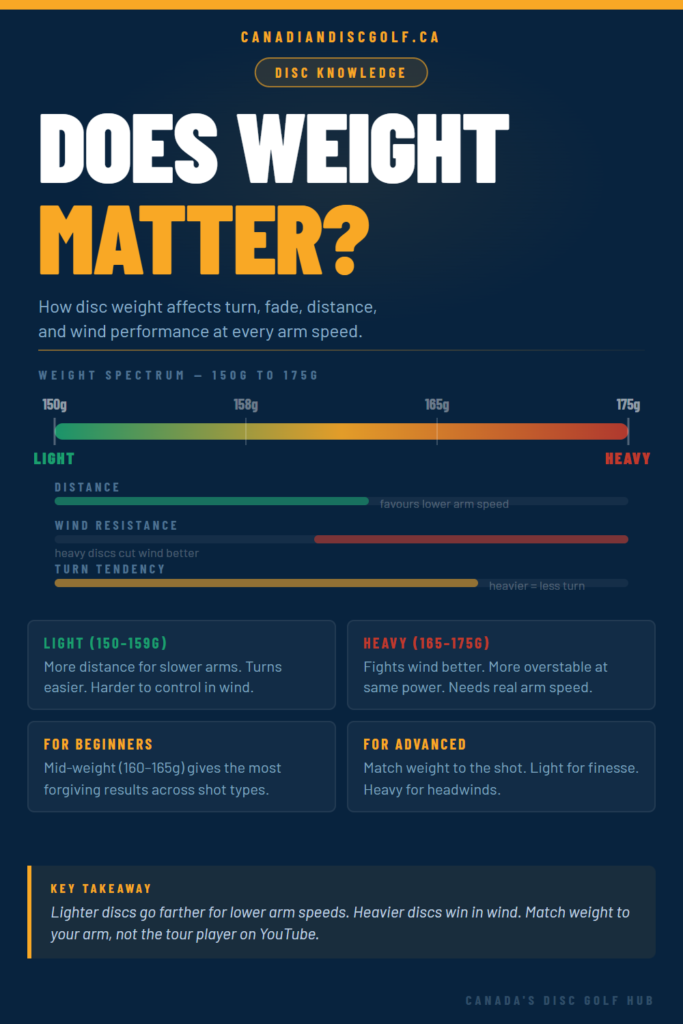
Understanding Disc Weight: How It Affects Turn, Fade, Distance & Wind
Most players buy discs based on what’s on the shelf or what someone recommended without giving weight much thought beyond a vague sense that lighter discs are for beginners. That’s partially true and mostly incomplete. Disc weight is a genuine flight variable that affects how your disc responds to your arm speed, how it behaves in wind, and how it turns and fades, and getting it right for your game is worth the ten minutes of actual thinking it takes.
The Basic Physics
A heavier disc resists the forces acting on it more than a lighter one. That sounds obvious but it has two specific consequences that matter on the course.
First, a heavier disc requires more arm speed to reach its rated flight characteristics. A 175g Innova Destroyer released at moderate power will fly more overstable than its rating suggests, because the disc’s gyroscopic stability hasn’t been fully loaded. That same player throwing a 165g version of the Destroyer gets closer to the disc’s intended flight at the same power output. This is why experienced players sometimes recommend lighter versions of overstable discs to players who are building arm speed: you get more honest feedback from the disc before your power catches up to the full-weight version.
Second, a heavier disc is less affected by wind. More mass means more resistance to being pushed around by a crosswind or knocked down by a headwind. This is why most high-level players throw maximum-weight discs for anything thrown into a significant headwind, and why a 150g disc that flies beautifully on a calm day can become genuinely unmanageable in a prairie gust.
Light Discs: Who They’re Actually For
Lighter discs, generally in the 150–160g range, produce more distance for players who don’t have the arm speed to load a full-weight disc. The disc is easier to accelerate to the speed it needs for its rated flight, which means a slower arm gets more out of the disc’s designed glide and turn characteristics.
For newer players or younger players still developing arm speed, this is real and meaningful. A 150g Innova Leopard3 in the hand of someone with moderate arm speed will fly considerably farther and more predictably than a 175g version of the same disc, because the lighter disc actually reaches the speed it needs to flip up and glide. The heavier version just fades out early and looks overstable when it isn’t.
The trade-off is wind sensitivity. Under calm conditions, light discs are a legitimate tool at any skill level. When the wind picks up, you pay for the lower mass in unpredictability.
Heavy Discs: The Wind and Control Case
Above 165g, discs become genuinely more wind-resistant and, for players with enough arm speed, more controllable. The flight is more repeatable because the disc is less reactive to small environmental variables. A player who has developed consistent arm speed will often gravitate toward heavier discs for that predictability alone, even in calm conditions.
There’s also a specific use case for heavy discs in overhand and roller shots. A maximum-weight disc thrown on a thumber or tomahawk line holds its intended trajectory better than a light disc that gets pushed around mid-flight. For Canadian courses with consistent wind exposure, particularly open courses on the prairies or coastal areas, having a few heavy discs in the bag specifically for windy rounds is a reasonable strategy.
What This Means for Putting
Weight matters in the putting game too, though the scale of impact is smaller within the typical putter weight range. Many players prefer heavier putters because the extra mass makes the disc feel more stable in the hand and less reactive to a slightly imperfect release. Others prefer mid-weight putters for the softer feel at the basket.
The Dynamic Discs Judge and the Discmania P2 both come in a range of weights, and players who throw both versions often describe the heavier versions as feeling more locked-in on the push putt, particularly in light wind. If your putting mechanics are already consistent, experimenting with a gram or two heavier in your putter can sometimes tighten the scatter pattern on longer attempts.
A Simple Framework
If you’re still developing arm speed, stay in the 160–168g range for mid-ranges and fairway drivers, and don’t buy max-weight distance drivers regardless of what the guy throwing 400 feet on YouTube is using. His arm speed and yours are different equipment.
If you throw with real power and consistency, max-weight discs give you better wind resistance and more predictable flight numbers across conditions.
If you play a lot of rounds in wind, carry at least a few discs at maximum weight for those conditions specifically, even if your general bag runs lighter.
Weight is a small adjustment with real results. It costs nothing to pay attention to.