
Disc Golf Putting Styles Compared: Spin, Push & Turbo
Putting is where rounds either hold together or quietly fall apart. You can drive beautifully, approach with precision, and then leave yourself a six-metre putt that feels completely manageable, and still three-putt your way to a double bogey. The green is its own game inside the game, and the mechanics you use to get the disc into the basket matter more than most recreational players realize until they’ve spent real time with them.
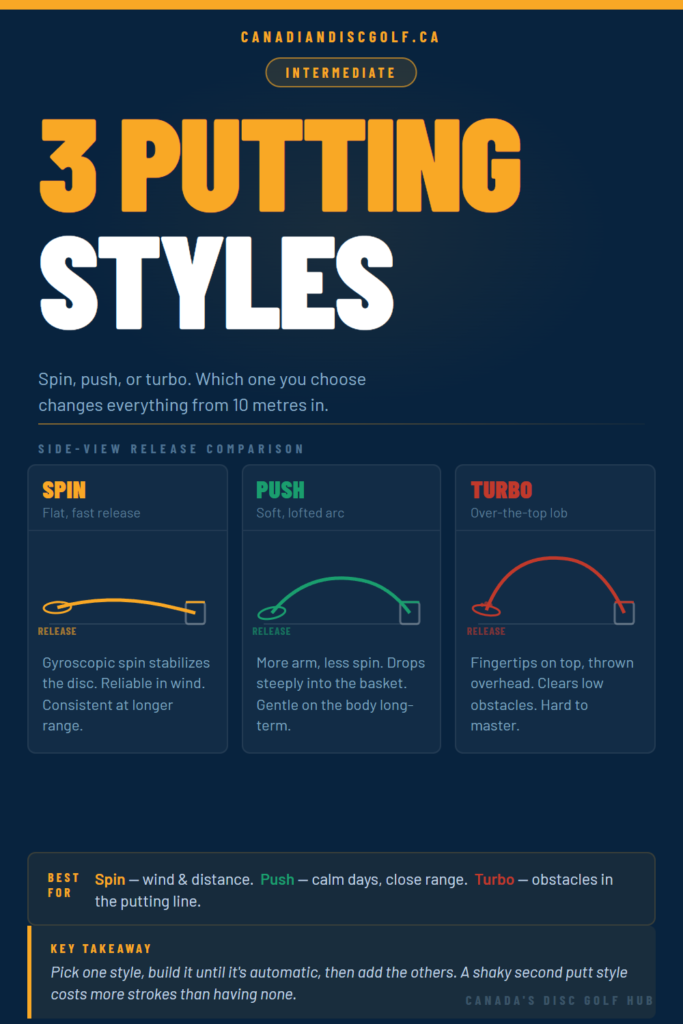
There are three main putting styles in disc golf: the spin putt, the push putt, and the turbo putt. Every player eventually lands somewhere on the spectrum, sometimes through deliberate experimentation, usually through default, and rarely with a full understanding of what each style actually does and why it behaves the way it does under pressure. Getting that understanding now will save you a lot of confused misses later.
The Spin Putt
The spin putt is the most commonly taught style and, for most players, the most reliable foundation to build on. The mechanics are straightforward: you release the disc flat with significant rotational spin, the same fundamental motion as your backhand throw but scaled down for putting range and power. The spin stabilizes the disc through gyroscopic force, meaning even if your release angle is slightly off, the rotation keeps the disc on a predictable path rather than wobbling or flipping.
That stability is the spin putt’s main advantage, and it becomes especially pronounced in wind. A spinning disc resists being pushed around by crosswinds better than a slow-spinning one. If you’re playing a course with consistent wind exposure, particularly on open prairie courses like many found across the Canadian prairies, a reliable spin putt is close to essential. The disc simply doesn’t care as much about a light headwind or quartering crosswind.
The trade-off is that spin putts require more precise release angle management. A disc thrown with high spin on a slight anhyzer will turn over before it reaches the basket. A disc thrown with high spin on too much hyzer will fade out early and land left of the target (for right-hand throwers). The spin amplifies whatever angle you release on, which means small release inconsistencies get magnified rather than absorbed. This is why spin putters spend a lot of time on release consistency drills, because the technique rewards precision and punishes sloppiness more directly than the push putt does.
The Push Putt
The push putt uses more of a linear, pushing motion with less spin imparted at release. The disc travels on a higher arc, drops more steeply toward the basket, and because the low spin means less rotational resistance, it tends to fall in softly from above rather than crashing through at a flat angle.
That steep entry angle is genuinely valuable. A disc dropping nearly vertically into the basket from above is harder to reject (kick out) than a flat disc arriving at a similar speed. If you’ve ever watched a spin putt hit the top of the chains and bounce straight out while a push putt at similar distance seems to just absorb into the basket, you’ve seen this difference at work. Push putts are forgiving in a specific way that matters on close-range shots.
The style also tends to be easier on the arm over time. The pushing motion is less repetitive-strain intensive than the snap and release of a high-spin putt, which matters for players who practice putting a lot or who play multiple rounds per week. This is one of the reasons some older and more experienced players migrate toward push putting over their careers.
The limitation is wind. A slowly spinning disc is significantly more vulnerable to being pushed off-line by crosswinds. On calm days, a push putt can be the highest-percentage style available. On breezy days, it can become genuinely unpredictable past circle one range. If you’re developing a push putt as your primary style, you’ll want a secondary plan for windy conditions.
Discs matter more with push putting than many players expect. A putter with a flat top and overstable fade characteristics will drift left consistently on a push putt. Something neutral to slightly understable, like a Dynamic Discs Judge or an Innova Aviar, tends to give push putters more forgiving, predictable results because the disc’s stable-neutral flight complements the low-spin delivery rather than fighting it.
The Turbo Putt
The turbo putt is the outlier. Grip changes entirely: instead of holding the disc with fingers under the rim in a standard putting grip, you hold it with fingertips on top of the disc, almost like balancing it on your hand. The release is an overhead lob motion, disc thrown upside down relative to the standard orientation, creating a steep arcing flight that drops almost straight down into the basket.
Why would you ever want to throw a disc upside down into a basket? One reason: obstacles. If there’s a tree branch, a slope, or a shrub between you and the basket that a standard flat putt can’t clear, a turbo putt’s high-arcing trajectory can go over and above it. The disc comes down at such a steep angle that it clears obstacles a conventional putt couldn’t navigate.
Most players never develop a reliable turbo putt, and honestly, most players don’t need one as a primary style. It has a steep learning curve, it’s inconsistent at longer distances, and it’s genuinely difficult to control in wind. But as a situational specialty shot for specific course obstacles, it’s worth knowing how it works even if you only reach for it a handful of times per season. Some Canadian wooded courses will present situations where it’s the most sensible option on the card.
Which Style to Choose
The practical answer for most players starting out or rebuilding their putting game: start with the spin putt. The mechanics connect directly to skills you’re already developing in your full throws, the style handles wind reliably, and the large volume of instructional content available for spin putting makes it easier to troubleshoot when something goes wrong. A solid beginner disc setup should include at least two putters, partly for putting practice with back-to-back reps from the same spot.
If you’ve been spin putting for a while and your technique feels locked in but your short-range misses are mostly reject-based (disc hitting the chains and bouncing out), it’s worth experimenting with the push putt at five to seven metres. The steep entry angle may solve that specific problem.
The mistake to avoid is trying to develop both styles simultaneously at the start. Split practice time between two putting mechanics before either one is automated and you end up with two unreliable putts instead of one solid one. Pick a primary. Build it until it’s automatic. Then experiment with the secondary when your primary is no longer the thing you’re worried about on the course.
A Note on Putters Themselves
Putting style and disc choice interact more than people acknowledge. A deep-rimmed putter built for spin putting (like the Kastaplast Berg or the Discmania P2) sits differently in the hand than a shallower approach-style putter. The Discraft Zone is a beloved approach disc but an unconventional putting choice because of its overstable fade. The Axiom Envy has become a popular option for players who want a consistent, neutral flight that works with both spin and push mechanics.
The point isn’t to tell you which putter to use. It’s to say that if your putting style feels technically correct but the disc keeps doing something unexpected at the basket, it might be the disc and not just you. Experiment deliberately.
Practice That Translates
Whatever style you commit to, the practice structure that produces the fastest improvement is the same: start close, track your percentage, and move back only when the close range feels automatic.
Five putts from three metres. Five from five. Five from seven. Five from ten. Record your makes, even just a rough count. Return to that drill every session and watch the numbers move. The style you choose matters less than the repetition you put into it. Two putts that land in the basket beat one putt that looks technically perfect and glances off the top of the cage.