
Tournament Prep and Mental Warm-Up Routines: How to Actually Be Ready When It Counts
Showing up to a tournament and trying to shake off rust on hole one is a plan. It’s just not a good one. The first few holes of a competitive round are when most recreational tournament players give strokes away that have nothing to do with skill and everything to do with not being ready to play when the card started.
Getting ready is a skill. It’s learnable, it’s repeatable, and it has nothing to do with being a professional. The players at your local am tournament who consistently open with pars aren’t necessarily better throwers. They’ve just figured out what their body and brain need before competitive pressure kicks in.
The week before: scouting and routine-setting
If the course is one you’ve played before, this is the time to revisit your notes from prior rounds. Which holes gave you trouble? Which lines were you uncertain about? Not to dwell on mistakes but to make decisions in advance so you’re not making them cold under pressure on the day.
If possible, play a practice round on the tournament course in the week leading up. Not to shoot a score. To walk every hole with the specific question: what is my tee shot here, and what’s my bailout if that goes wrong? Deciding these things in advance removes one layer of in-round cognitive load. On hole seven in round two, you want to be executing a decision you already made, not making it fresh while your playing partners watch.
Set your bag the day before. Not the morning of. Deciding in the parking lot whether to pull a disc out or add one is friction you don’t need. Check your discs for damage, make sure your bag is organized the way you want it, and leave it ready to grab.
Morning of: timing your arrival
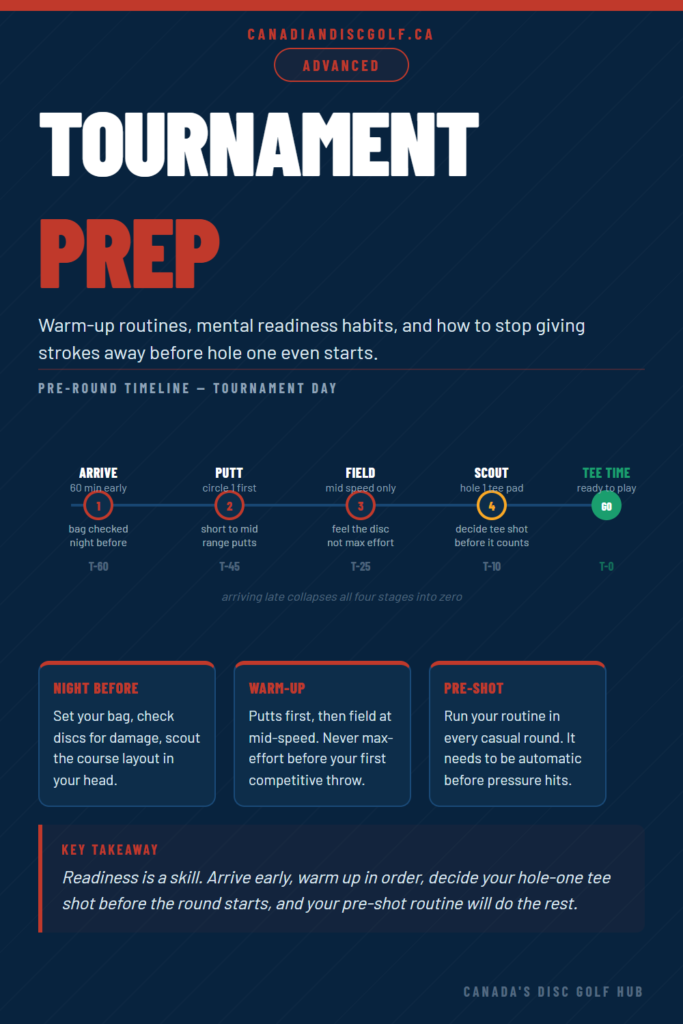
Get there early enough to actually warm up, not just early enough to not be late. For most players that means arriving at least forty-five minutes before your tee time, ideally an hour. Rushing to the first tee pad still half-asleep and hoping your first throw goes somewhere useful is not a warm-up. It’s a gamble.
What you do with that time matters. The instinct for many players is to immediately start throwing distance drivers at maximum effort to “loosen up.” That tends to produce sore muscles and a false read on how your arm is actually feeling that morning. Start slow. A few minutes of putting from short range, then medium range. Your arm is telling you something in those first few throws. Listen to it before you start ignoring it.
Field work on the warm-up range, if the venue has one, should be conversational in pace. Throw mid-speed, focus on clean release rather than distance, and work through a few different discs you’ll rely on in the round. The goal is to feel the disc in your hand at game speed, not to max out before you’ve thrown a competitive throw.
Putting practice is the highest-return warm-up activity for most am players. Circle-one putts (inside 10 metres) should feel automatic by the time you walk to hole one. If they don’t feel automatic in warm-up, you’ve identified something to manage mentally during the round rather than being surprised by it on the course.
The mental warm-up: what it actually means
Mental warm-up is not positive self-talk in the mirror. It’s getting your decision-making into competitive mode before the round starts rather than spending holes one through three figuring out where your head is.
A useful pre-round habit: walk to the first tee pad before your round starts and stand there for two minutes. Look at the hole. Decide your tee shot. Decide your bailout. Then walk away. You’ve now made that decision in a low-stakes moment instead of a high-stakes one. It sounds trivial. The effect on your first tee shot is not.
Competitive pressure changes how you process information. Under pressure, most players default to their most ingrained habits, which is why having solid pre-shot routines matters so much more in tournament play than in casual rounds. Your pre-shot routine in casual rounds is the same routine you’re going to reach for when the card is close. If you don’t have one, build it before tournament season. If you do have one, run it consistently in every casual round so it’s genuinely automatic by the time you need it.
The mental connection to managing a disc golf round mentally is direct here. Everything in that framework applies during a tournament round, with the stakes raised. Bogey recovery, the 80% shot, staying in the present hole rather than projecting ahead. Know those habits before you put them under pressure.
Scorecard, card etiquette, and competitive specifics
A few things that trip up first-time tournament players regardless of skill level. Know the rules for marking your lie. Know what happens if you lose a disc. Know the local rules for OB on the specific course you’re playing, because they vary. Showing up and learning these things from your playing partners mid-round costs you focus at exactly the wrong moment.
Introduce yourself to your card at the start. You’re going to spend four-plus hours with these people. A brief, relaxed introduction sets a better tone than silently starting the round with strangers. Card atmosphere affects your comfort level, and your comfort level affects your play.
Don’t announce your score on every hole unless you’re asked. Keep your own running total mentally but resist the urge to narrate it out loud. Players who constantly track their score verbally tend to either jinx themselves or create pressure they don’t need. Know your score. Keep it internal. Respond when asked.
What “ready to play” actually feels like
Your arm is warm. Your putts have been going in. You’ve stood on the first tee and made your decision already. You know what’s in your bag and why each disc is there. You’ve eaten something, you have water, your shoes have grip.
That’s it. Not confidence that you’ll shoot your best round. Just readiness. The round will have surprises regardless. What preparation gives you is the capacity to handle them without getting rattled, which is a competitive advantage that has nothing to do with arm speed or years of experience.