
Managing a Disc Golf Round Mentally: Bogey Recovery, Decisions Under Pressure & Course Management
Bad holes happen. Every round, to every player, at every skill level. The difference between a good round and a train wreck usually isn’t the bad hole itself. It’s what you do on the next three.
Disc golf rewards patience in a way that doesn’t always feel fair. You can stripe five holes in a row and give them all back on a single blow-up. A double bogey isn’t just two strokes — it can poison your decision-making for the rest of the round if you let it. The players who score consistently aren’t necessarily throwing better. They’re recovering faster.
The two minutes after a bad shot
There’s a window right after something goes sideways where most of the damage actually happens. The disc is in the trees, or it skipped into the water, and suddenly you’re making the next decision from an emotional place instead of a strategic one. That’s where rounds fall apart.
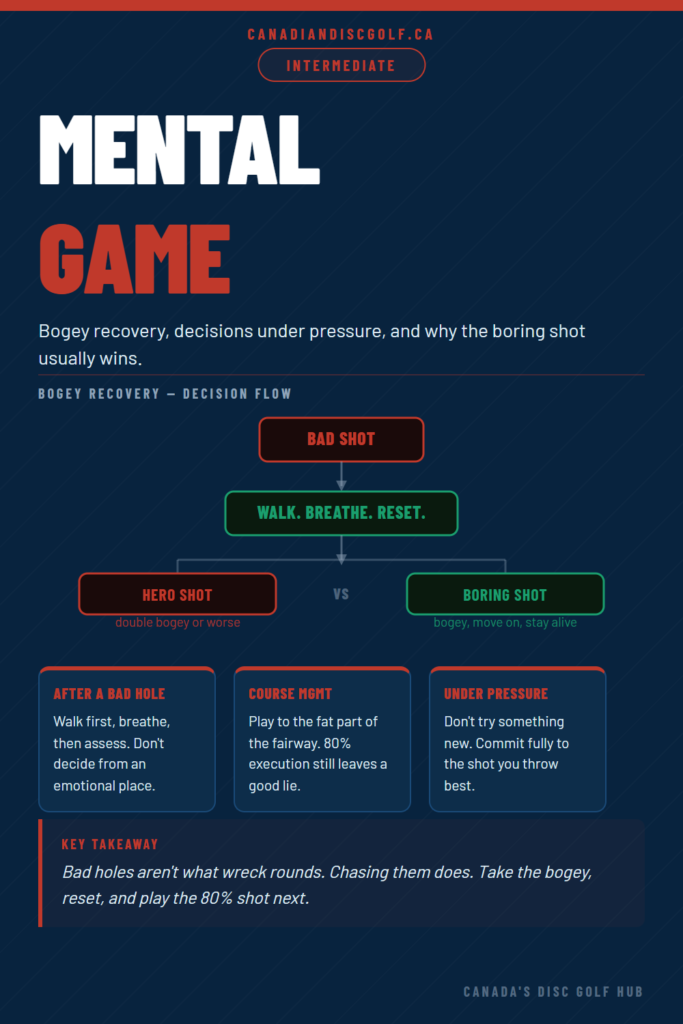
The first thing to do is nothing. Walk to your disc. Don’t start evaluating options while you’re still annoyed. That sounds obvious but almost nobody actually does it. A full breath before you even look at your lie goes a long way.
Then do a quick reset: what’s the par for this hole, what’s a realistic score from here, and what shot gets you there with the lowest risk? A bogey isn’t a catastrophe. If you’ve just made a double and you’re already at one over for the round, par on the next hole puts you in fine shape. The round isn’t over. It rarely is when it feels like it is.
What kills rounds is the revenge mentality — trying to birdie your way out of a bad stretch immediately. You take on an aggressive line you have no business throwing at that moment, miss it, and now you’re three over on a hole that should have been one. That sequence, not the original mistake, is what wrecks scorecards.
Course management is mostly about choosing boring
Most recreational players have a bad habit of playing to the pin regardless of where the pin is. Tournament players do something different: they play to the fat part of the fairway and let their disc do the rest.
Before every tee shot, identify the danger. Is there water left? A slope that feeds into rough? A basket placement that punishes the aggressive line? Then ask yourself: what shot, if I execute it to 80% instead of 100%, still leaves me in a good position?
That’s the shot you throw. Not the hero shot. The 80% shot.
This matters especially on holes where one side is much worse than the other. A missed shot that lands in the rough on the right side of a fairway is a one-stroke recovery. The same miss that goes into the water on the left is a penalty plus a drop plus a difficult lie. You’re not playing the same gamble — the risk profiles are completely different. Playing away from the worst miss is almost always the right call.
Understanding disc golf scoring — what’s actually realistic for your skill level on a given hole — helps with this. If you’re a bogey golfer on a hole rated at a difficulty you consistently struggle with, par is a win. Take par and move on. Don’t manufacture pressure that isn’t there.
Decision-making under actual pressure
When a shot really matters — final hole of a casual tournament, trying to beat a personal best, playing with someone you want to impress — the instinct is to think harder about it. Analyze more. Run through more options.
Usually the opposite helps. Go back to the most basic version of what you do well. Don’t try something new under pressure. Don’t suddenly decide to throw a forehand line because it looks better when you’ve been a backhand player the whole round. Stick to what you know. Commit to it fully.
Routine helps here. A short physical reset before each throw — a couple practice swings, a breath, a spot on the ground you look at before your run-up — gives your brain something to do besides spiral. It doesn’t need to be elaborate. It just needs to be consistent.
Pre-shot indecision is the other killer. If you’re standing at the tee pad and you genuinely can’t decide between two shots, that’s usually a sign you’re not confident in either one. Pick the safer of the two. An uncommitted throw to the right line almost always goes worse than a committed throw to the conservative line.
The reset between holes
Whatever just happened, the walk to the next tee pad is your reset window. Use it. Some players do this physically — shaking out tension, rolling shoulders — because the body carries frustration in ways that mess with your release. Some just let themselves briefly acknowledge the bad hole out loud, then put it away. Whatever works for you.
What doesn’t work: replaying the bad shot mentally while walking to the next tee. That just keeps the frustration in the present tense, and it shows up in your next throw.
A simple habit: make one observation about something you like as you approach the next tee. The tree line, the basket placement, the open fairway. It sounds almost embarrassingly small. But it breaks the loop, and breaking the loop is the whole job.