
Throwing in Strong Crosswinds: Disc Selection, Release Angles & What Actually Works
Wind is the part of disc golf that separates players most reliably. Two people with identical form and identical discs can stand on the same tee pad and get completely different results if one of them understands what the wind is doing to their disc and the other is just hoping it works out. In calm conditions, mistakes are forgiven. In a crosswind, they get amplified.
Crosswinds are the trickiest category because they don’t just push your disc sideways — they interact with the disc’s spin and stability in ways that aren’t immediately obvious. The direction the wind is coming from changes everything about how you should respond.
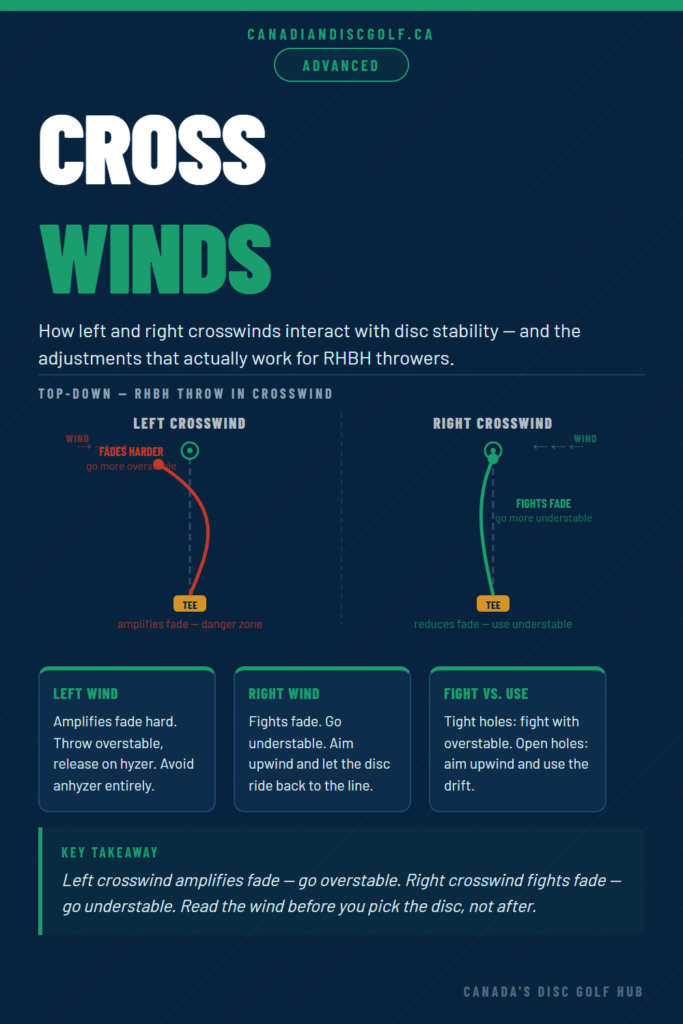
Left crosswind for RHBH: the one that bites
A left-to-right crosswind (wind pushing from your left to your right as you face the target) is the dangerous one for right-handed backhand throwers. Here’s why: your disc naturally fades left at the end of its flight. A left-to-right crosswind gets under the disc’s left edge and amplifies that fade — sometimes dramatically. An understable disc thrown into a left crosswind can turn completely over and go right before flipping back left in an uncontrolled S that lands nothing like intended. Even a neutral disc will fade harder and earlier than you expect.
The adjustments that work here: throw more overstable than you would in calm conditions. A disc with a fade of 2 in still air should behave like a fade-1 disc once the left crosswind is fighting its tendency to fade. Bump up to fade 3 if the wind is genuinely strong. Your Teebird becomes your Firebird. Your Buzzz becomes your Roc3. Think of the crosswind as a stability reducer on whatever disc you’re holding, and compensate accordingly.
Release angle also matters. Throwing on a slight hyzer in a left crosswind lets the wind work with the disc’s natural shape rather than getting under the wrong edge. Anhyzer releases in a left crosswind are generally a mistake — you’re giving the wind a ramp to flip the disc completely.
Right crosswind for RHBH: surprisingly manageable
A right-to-left crosswind (wind coming from your right) pushes against the fade rather than amplifying it. The disc still wants to go left, but the wind is pushing it back right — the two forces partially cancel. The result is that a right crosswind actually straightens out overstable discs and makes slightly understable discs fly more neutral.
This is the crosswind that rewards understable discs. If you have a disc that normally turns too much in calm air but you’ve been keeping it in the bag, a right crosswind is exactly when to pull it out. The turn gets pushed back by the wind, the disc rides the crosswind into a straighter line than it could manage otherwise.
The trap here is getting overconfident. A strong right crosswind can still cause a very understable disc to ride too far right and never fade back. Read the wind strength honestly and don’t go more understable than the wind can correct for. A disc with turn of -3 is probably fine in a moderate right crosswind. Turn of -5 in a strong right crosswind is still a gamble.
Understanding overstable vs understable disc behavior in still air is the baseline for all of this. If you don’t have that framework already, crosswind adjustments are going to feel like guesswork because you’re adjusting relative to a baseline you haven’t established.
Throwing into the crosswind vs. using it
There are two philosophies for crosswind shots, and experienced players use both depending on the hole.
The first is fighting the wind: pick a disc stable enough to hold its line despite the crosswind, aim straight at your target, and muscle through it. This works on tight holes where you can’t afford to let the disc drift — a tree-lined tunnel where a right-to-left push would send you into the left rough, for example. Overstable discs with high fade hold their line better than understable ones in crosswinds because they’re already resisting turn. The fade is predictable even when the wind isn’t.
The second is using the wind: aim upwind of your target and let the crosswind carry the disc back. If there’s a right-to-left wind and your target is center fairway, aim ten or fifteen feet right of center and let the wind push it back. This works best on open holes with room to drift and is often more effective than fighting the wind on longer shots where even an overstable disc will get pushed around eventually.
The decision between these approaches comes down to the hole layout and your confidence in the wind’s consistency. Gusting, unpredictable wind argues for fighting it with a stable disc. Steady, directional wind argues for using it with the right aim line.
A note on headwinds, tailwinds, and the crosswind component
Most real-world wind hits at an angle rather than perfectly left-to-right or right-to-left. A wind from the front-left has both a headwind component and a left crosswind component. Parse them separately: the headwind component means you need more disc speed and possibly more overstability; the crosswind component means you apply the left-crosswind logic above. On gusty days, conditions can shift hole-to-hole, so re-read the wind before each tee shot rather than assuming the adjustment you made on hole six still applies on hole seven.
The players who handle wind best aren’t necessarily throwing harder or gripping tighter. They’re reading the wind direction before they pull a disc, adjusting their selection deliberately, and committing to the throw without second-guessing mid-motion. That last part is worth repeating. Hesitation on a windy tee pad usually produces the worst result of the available options.