
The Best Disc Golf Seasons in Canada by Region: When to Play, When to Prepare
Canada doesn’t have one disc golf season. It has four or five, depending on where you live, and they look completely different from each other. A player in Victoria can reasonably expect to throw discs year-round. Someone in Winnipeg is looking at a hard window from roughly late April to October, and even that comes with conditions on either end. Planning around your region makes a real difference in how much you actually play versus how many rounds you miss because the course isn’t ready or conditions caught you off guard.
British Columbia: the longest window
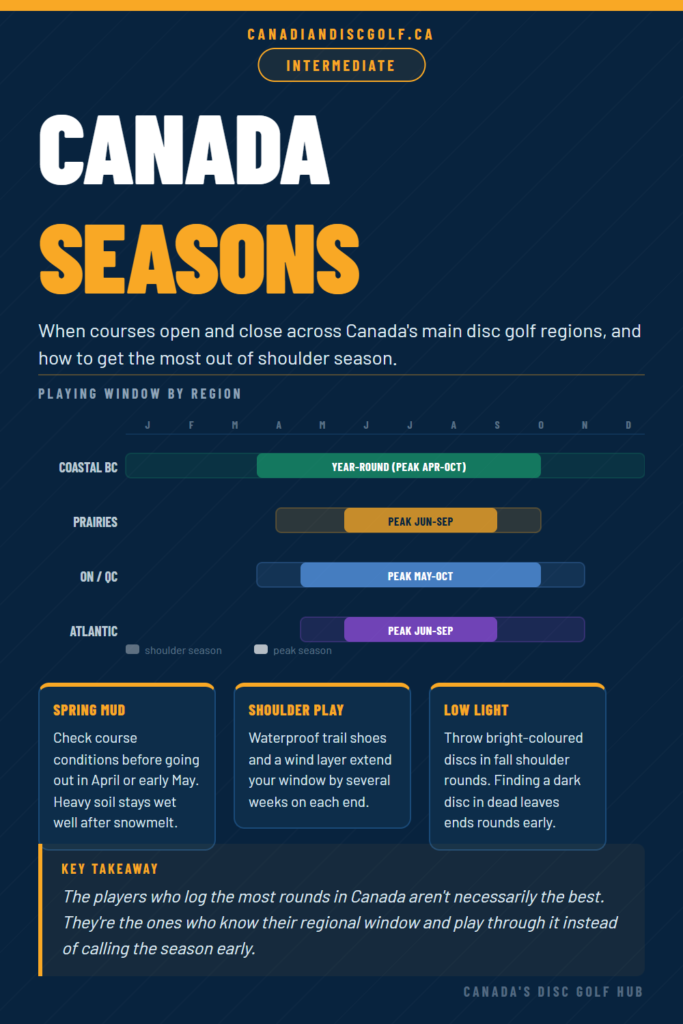
Coastal BC, particularly the Lower Mainland and Vancouver Island, is the closest thing Canada has to year-round disc golf. Victoria players routinely throw in January and February. Temperatures stay above freezing most days, courses remain accessible, and the main adversary is rain rather than snow or ice. The cold weather and wet conditions articles are more relevant here than anywhere else in the country simply because the season never fully stops.
Peak season on the coast runs April through October with reliably good conditions. November through March is playable but requires proper rain gear and the expectation that your discs will fly slightly more overstable in the damp, heavy air.
Interior BC is a different story. Kelowna, Kamloops, and the Okanagan get genuine winter with snow accumulation and frozen courses from December through March. The tradeoff is drier, warmer summers that produce outstanding disc golf conditions from May through September.
Prairies: short and intense
Saskatchewan, Manitoba, and Alberta share a similar pattern: a compressed but excellent disc golf window. Courses typically open in late April, sometimes early May depending on how wet the spring has been. Snowmelt creates soggy fairways that need time to drain before they’re worth playing on. Pushing too early means torn-up turf and frustrating lies.
The summer window from June through August is genuinely good in most Prairie cities. Long daylight hours, warm and usually dry conditions, and courses that are well-maintained through peak season. This is when Prairie disc golf is at its best.
September is the shoulder month. Still playable, often beautiful with fall colours, but cooling fast. October can go either way. Some years it’s fine through Thanksgiving weekend. Other years the first snow hits in late September and the course is done for practical purposes.
For Winnipeg and Regina players especially, the short window makes the early and late season worth pushing into. A round on a cold but snow-free October day in proper gear is worth taking rather than waiting for the season to fully close.
Ontario and Quebec: variable but generous
Southern Ontario and the greater Montreal area have a longer window than the Prairies with more variability. Courses in the Toronto and GTA area start becoming reliably playable in April, with some hardy players going earlier. The season runs comfortably through October and sometimes into November on mild years.
The spring shoulder season in Ontario often means dealing with mud. Courses built on heavy clay soil stay wet well into May following snowmelt. Checking course conditions before heading out in April or early May saves frustration. Most established clubs post course condition updates through their social channels.
Quebec’s season mirrors Ontario’s at the southern end but compresses faster as you move north. Montreal has a similar window to Toronto. Quebec City plays more like a Prairie city, with a reliable June through September core season and shoulder months that require flexibility.
Northern Ontario and northern Quebec trend toward the same compressed window as the Prairies. The upside is access to genuinely spectacular wilderness courses that see far less traffic than urban southern courses.
Atlantic Canada: mild but maritime
New Brunswick, Nova Scotia, PEI, and Newfoundland benefit from maritime climate moderation. Temperatures are milder than the Prairies and interior Quebec in both directions, meaning summers don’t get as hot and winters don’t get as brutal. The disc golf window in the Maritimes runs roughly May through October with reasonable reliability.
The main challenge is wind. Coastal exposure on many Atlantic Canada courses means dealing with crosswinds that simply aren’t a factor on sheltered Prairie courses. Players who develop their game in the Maritimes tend to get good at wind management earlier than players from more sheltered regions.
Making the most of shoulder season
Wherever you are, the shoulder months at both ends of the season reward a bit of preparation. Gear-wise, waterproof trail shoes and a wind-blocking layer extend your comfortable playing range by several weeks on each side. Disc selection adjusts too — dense cold air means throwing slightly more understable than usual and expecting less carry distance.
Daylight is the other variable. Canadian shoulder season rounds often mean finishing in fading light. Brightly coloured discs are easier to track and find in low light. It sounds like a small thing until you’re searching for a dark blue disc in dead leaves with ten minutes of light left.
The players who accumulate the most rounds per year in Canada aren’t always the most talented. They’re the ones who’ve figured out their regional window and actually play through it rather than treating the first cold snap as the end of the season.