
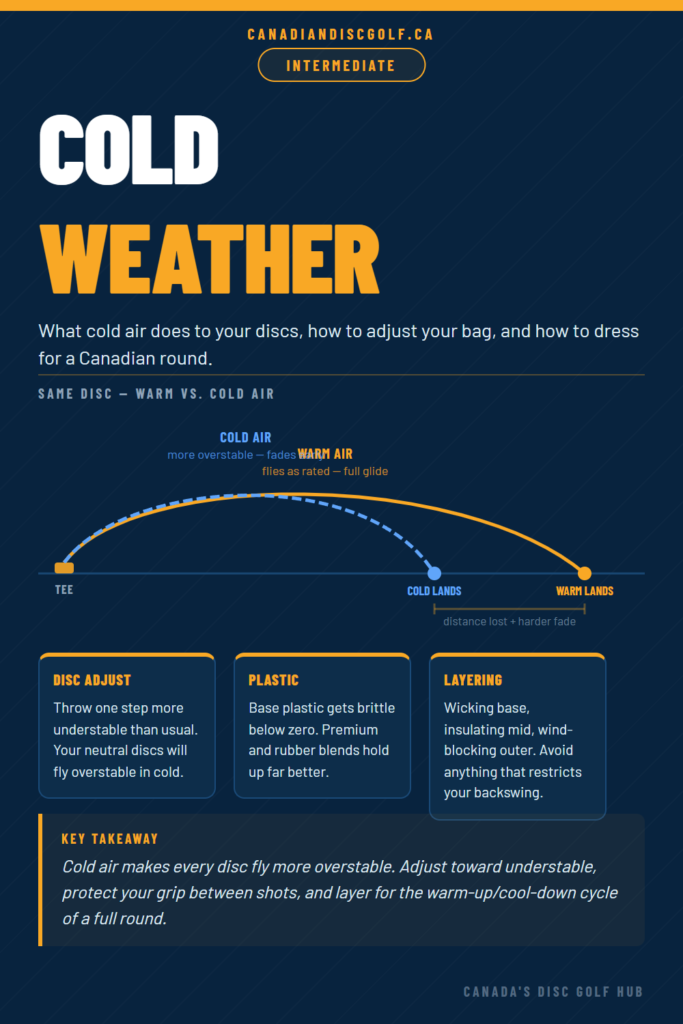
Disc Golf in Cold Weather: What Actually Changes & How to Handle It
Canada doesn’t really do mild. You get a few weeks of ideal shoulder-season weather in spring and fall, and then it’s either shorts weather or you’re playing in a toque. Plenty of Canadian players pack it in for the winter. The ones who don’t tend to discover something: cold-weather disc golf is genuinely enjoyable once you understand what’s actually happening to your discs and your body, and adjust for it.
Cold makes your discs more overstable
This is the thing that catches players off guard most often. You’ve thrown a particular disc for a whole season. You know exactly what it does. Then October hits and suddenly it’s fading a full body-width earlier than expected. The disc didn’t change. The air did.
Cold, dense air creates more drag on a spinning disc. More drag means the disc loses speed faster than usual, and a disc that loses speed early acts more overstable than its flight numbers suggest. Your neutral fairway driver starts flying like a slightly overstable one. Your slightly overstable disc becomes almost unworkable for straight shots.
The practical adjustment: reach for discs that are one step more understable than you’d normally throw in that condition. If you usually throw a Teebird on a straight tunnel, try a Leopard3 or an Escape. Your overstable approach discs will still work — they just might fade even harder, which can actually be useful. But your go-to neutral distance discs will need a replacement for cold rounds, at least until you’ve played enough cold weather to calibrate your expectations disc by disc.
This is also why understanding overstable vs understable matters before cold weather hits. If you don’t have a feel for your discs’ natural stability, adjusting for temperature is mostly guesswork.
Premium plastic gets stiff, base plastic gets dangerous
Plastic behavior in cold is significant, and different plastics respond differently. Premium plastics — Star, Champion, Z-Line, Lucid, Opto — stiffen up noticeably below zero. They still fly fine, but they lose some of the flex that gives them feel in the hand. Not a huge issue for most players.
Base plastics are a different story. DX, Pro-D, Base Blend — anything soft and grippy at room temperature can get genuinely brittle in deep cold. A disc that takes a hard hit to a cart path or a frozen tree root at -15°C can crack. It’s not guaranteed, but it happens. If you have an older, beat-in base plastic disc you rely on for rollers or approach shots, leave it in the bag on the coldest days and use something you’re less attached to.
Rubber-blend and overmold putters hold up the best in cold. The Discraft Luna, Dynamic Discs Judge in softer blends, and MVP/Axiom rubber-rim putters all stay reasonably grippy and flexible well below zero. Worth knowing before your first -10°C putting session.
Grip is the other half of the problem
Cold hands grip differently. The fine motor control you rely on for a clean release suffers when your fingers are stiff. Gloves help, but they introduce their own texture and thickness that changes how the disc sits in your hand, especially for fan grip putters. Most players find that a thin liner glove gives a usable compromise — enough warmth to keep dexterity, light enough to still feel the disc.
Hand warmers in your pockets are standard practice for serious cold-weather players. Between shots, both hands go in. You throw, hands go back. It sounds like a lot of ritual but you’ll feel the difference by hole six.
Keep your discs in the bag or under your arm between shots rather than leaving them on the cold ground. A disc sitting on frozen grass for five minutes is noticeably colder to grip than one you’ve been carrying. Small thing, real difference.
Layering for a round that goes two-plus hours
The challenge with disc golf specifically is that you’re generating heat during your throw and then standing around for several minutes while your playing partners throw. You warm up fast on the drive, cool down during the walk. A standard winter coat isn’t designed for that cycle.
Base layer that wicks moisture away from your skin. Mid layer for insulation — fleece or a light puffer. Outer layer that blocks wind without being so thick it restricts your backswing. That’s the formula. The outer layer is the one most players get wrong. A heavy parka is fine for standing in a parking lot. It’s a problem on the tee pad when you can’t get your arm back without the jacket bunching.
Footwear matters more than most players expect. Waterproof trail shoes or light winter hikers with actual grip are worth it. Wet grass, frost, and mud are everywhere from October onward, and the last thing you need on a tee pad is to slip mid-throw. Your ankles and your scorecard will both thank you.
What to realistically expect from your game
Distance will drop. Cold air is denser, which means discs don’t carry as far even with a clean throw. The difference is meaningful but not dramatic — expect roughly five to ten percent less carry distance in genuinely cold conditions. Club up (reach for higher glide or slightly more understable) to compensate.
Your round will probably feel harder than equivalent summer rounds. Partly the cold, partly the fact that most players throw fewer rounds in the off-season and come back rustier in spring than they expect. The players who play through winter tend to start the new season noticeably sharper. That’s the actual competitive argument for cold-weather golf, beyond just enjoying it.
Dress right, adjust your disc selection toward understable, protect your hands between shots, and you might find you actually enjoy having courses mostly to yourself. There’s something genuinely good about a disc golf course in November.