
Playing Disc Golf in the Rain: Grip, Disc Selection & What to Actually Carry
Rain is not a reason to stay home. Most dedicated disc golfers figure this out eventually, usually after getting caught mid-round in a downpour and discovering the game is still playable. The courses empty out, the pace of play drops, and if you’re prepared for it, a wet round can be genuinely enjoyable. If you’re not prepared, it’s miserable and your score shows it.
The gap between prepared and unprepared in the rain is almost entirely equipment and habit. The throws themselves don’t change much. What changes is everything around them.
Grip is the whole problem
A wet disc in bare hands is a liability. The snap you rely on for a clean release gets replaced by a slippery half-release that can go almost anywhere. Players who’ve never thought about grip in dry conditions suddenly can’t throw the discs they’ve thrown a thousand times.
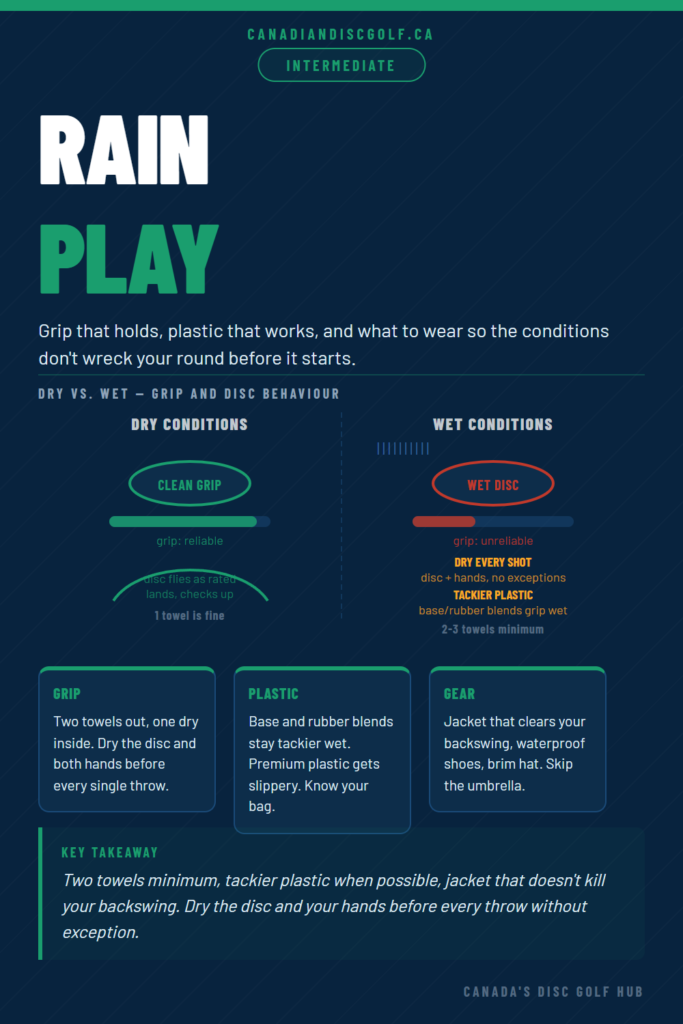
Towels are the foundation of a wet-round setup. Not one towel. At least two, ideally three. One lives on the outside of your bag for quick access. One stays inside in a dry pocket or zip-lock bag, kept completely dry until the other ones are soaked through. The routine between shots becomes: dry the disc, dry your hands, throw. Every shot, without exception. Skipping it on one throw because you feel like you’re holding up the group is how you spray one into the trees on a hole you’d normally par without thinking.
Towel material matters more than most players realize. Microfibre dries discs faster and more completely than standard cotton. A small microfibre golf towel clipped to your bag strap is the single most useful piece of rain gear for disc golf, including a rain jacket.
Some players use rosin bags for extra grip in wet conditions, the same chalk approach used in ball golf. It helps, though it’s more maintenance than most casual players want to deal with. Grip-enhancing disc golf wax products exist too and are legal in most casual and tournament contexts. Worth knowing about if rain rounds are regular for you.
Which discs actually work wet
Tackier plastics grip better in rain. Base plastics, DX, Pro-D, base-blend rubber putters — tend to stay grippy even when damp because their softer surface texture holds better than the smooth, rigid surface of premium plastics. Your premium Star or Champion plastic discs will feel noticeably more slippery when wet.
This creates a practical argument for having at least some base or mid-grade plastic in your bag if you play in variable conditions. A beat-in DX midrange that you can actually grip is more useful in a rainstorm than a pristine premium fairway driver that slips on release.
For putters specifically, the rubber-overmold discs from MVP and Axiom hold up well in rain. The Discraft Luna in softer plastics stays grippy. The Dynamic Discs Judge in the base Prime plastic is another option players reach for when things get wet.
Rain also affects disc flight in ways that mirror some of what happens in cold weather, denser, heavier air means slightly more drag, which means discs act a touch more overstable than rated. The effect is less dramatic than cold, but on longer shots with high-fade discs you’ll notice it. Adjusting one step toward understable in heavy rain is worth considering on those specific shots.
What to wear and carry
A rain jacket that doesn’t restrict your backswing is non-negotiable. This is the same problem as winter layering, a jacket that bunches at the shoulders or limits your reach-back is actively hurting your throw. Disc-golf-specific rain jackets exist and are worth the price if you play year-round. General hiking rain shells tend to work fine too, as long as you try the throwing motion before committing to one in a round.
Waterproof shoes or at least water-resistant trail shoes. Wet grass and mud on a disc golf course gets slippery fast. The tee pads at most courses have some grip built in, but anything off the pads, which is where you spend most of your time in a disc golf round, is potentially slick. A slip mid-throw is a wasted throw at best, a turned ankle at worst.
A hat with a brim is underrated. Keeping rain off your face directly improves your ability to read the fairway and track your disc in flight. A soaked face squinting into a downpour is not the ideal condition for shot selection.
What not to bother with: an umbrella. You’re moving too much and throwing too often for an umbrella to be worth managing. Most bags have some weather resistance built into the outer shell. A rain cover for your bag if you have one is useful for longer waits, but during active play it’s more hassle than it’s worth.
Adjusting your game, not just your gear
Wet ground changes where discs land and what they do after. A disc that normally skips forward ten feet on dry hardpack will check up almost immediately on soggy grass. That’s actually useful on approach shots near the basket, wet ground stops discs faster, which means you can sometimes be more aggressive with a line that would have skipped past the basket in dry conditions.
Landing zones that slope are more treacherous. A disc landing on a wet slope will slide further in the direction of the slope than the same shot would in dry conditions. Read the ground as part of your landing-zone assessment, not just the air.
Distance expectations should come down slightly across the board. Not dramatically, but enough that you should lean toward more disc rather than less on holes where you’re right at the edge of your range. Coming up short in the rough is worse in rain because the lie is wetter, the grass clings to the disc, and the next throw is harder to execute cleanly.
The players who score best in rain aren’t the ones fighting hardest against the conditions. They’ve accepted the conditions as a fixed variable and adjusted everything else. That mindset, more than any specific gear choice, is what separates a functional wet round from a frustrating one.