
How to Throw in the Woods: Shot Selection, Gap Reading, & the Bump & Run
There’s a specific kind of humiliation that only wooded disc golf delivers. You’ve got a clean drive sitting in the fairway, a reasonable shot into the green, maybe forty metres through a gap that looks, from a distance, perfectly manageable. You pull your go-to fairway driver. You throw it well. It catches the left edge of the gap at about knee height and deflects hard into the bush, and now you’re punching out sideways just to get back in play.
The gap was never as wide as it looked. The disc was never the right choice. And “throwing it well” in an open field and throwing it well in tight trees are two entirely different skills that most players never separate in their minds.
Wooded play is its own discipline. The sooner you treat it that way, the faster your scores in bush-heavy rounds stop feeling like a lottery.
Read the Gap Before You Read Your Bag
Before you even think about which disc to throw, you need an honest measurement of what you’re working with. Not a rough estimate, not a hopeful squint. An actual assessment of the gap width, the ceiling height, and where the trouble lives if the shot goes wrong.
Walk up closer than feels necessary. Most players stand at the tee, eyeball the gap from maximum distance, and reach for whatever disc they throw well. The gap always looks wider from the tee than it is at disc height in the middle of the corridor. What reads as a comfortable two-metre window from thirty metres away might be less than a metre when you account for the disc’s full wingspan and trajectory curve.
While you’re up there, look at where the bad outcomes live. Is the miss right worse than the miss left? Does a high shot clip branches that a lower release angle would duck under? Is there a clean punch-out lane if you come up short? Understanding the consequences of a mistake before you throw is how you pick a shot with actual margin instead of just picking the one you’re hoping for.
Disc Stability Is the Whole Conversation
The central tension in wooded play is between stability and forgiveness. An overstable disc gives you a predictable, reliable fade, which means you know exactly where it’s going to end up even if the release angle isn’t perfect. That predictability is genuinely valuable in tight corridors. But overstable discs also fight your off-angle releases harder, and in thick trees where you sometimes can’t get a clean backswing, off-angle releases are the norm rather than the exception.
An understable disc is more forgiving of imperfect releases at lower power, which helps when you’re punching through a gap at sixty percent to keep the ceiling low. But understable discs turn over when thrown too hard, and in the woods, turning over almost always means finding a tree.
This is the core concept behind overstable vs understable discs applied to a specific, pressured context. In open field practice you can experiment and watch the full flight. In the woods, a disc that turns over is a disc in the bush. The practical upshot: most experienced wooded players rely on mid-ranges and fairway drivers rather than distance drivers for nearly every shot except the most open, highest-ceiling corridors. Mid-ranges have enough predictability to control in tight spaces and enough glide to cover real distance when thrown cleanly.
The Flex Shot: Your Best Friend Through a Tight Gap
The flex shot is the woods player’s primary weapon and it’s worth building a real understanding of what it does before you try to depend on it under pressure.
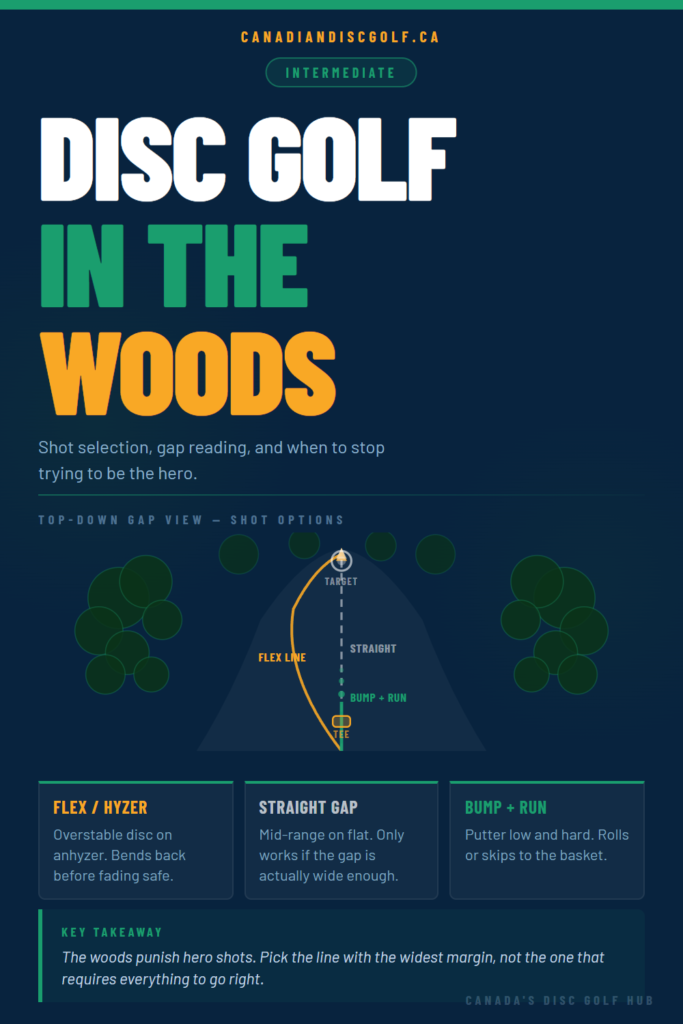
A flex shot uses an overstable disc thrown on a hard anhyzer angle. The disc goes out on a left-to-right curve (for a right-hand backhand thrower), and then the overstability kicks in and bends it back to the left, finishing with a reliable fade. The result is an S-curve flight that effectively lets you route a disc around objects it couldn’t fly through directly, or gives you two opportunities to thread a gap instead of one straight shot that either makes it or hits a tree.
The key variable is how much anhyzer angle you start with and how hard you throw. More anhyzer plus more speed equals more turn before the fade kicks in. Less anhyzer plus a relaxed power level equals a gentle flex that barely curves before fading back on the intended line. Developing a feel for that spectrum takes field work, and the only way to get it is to practice the shot with the specific discs you plan to use on the course. A Roc3 will flex differently than a Firebird at the same power level. You need to know your discs.
Understanding the Hyzerflip Option in the Woods
The hyzerflip has a specific and underused application in wooded play. If you need a long, dead-straight shot through a corridor and you can’t generate enough arm speed to keep an overstable disc from fading out early, an understable disc released on a hyzer angle can flip up to flat and then glide straight for a significant distance before any fade begins.
The risk is the same as always with understable discs in the trees: too much arm speed and it turns over. But when you find the right power level, a hyzerflip gives you a straight ball flight that neither an overstable nor a neutral disc thrown flat can reliably produce. For long, relatively open corridors with a high canopy, it’s worth having in your vocabulary.
The Bump and Run: More Useful Than It Looks
There’s a shot that veteran wooded players use constantly that beginners almost never try, mostly because it feels weird. The bump and run throws a putter low and hard, intentionally making contact with the ground before the basket, letting it roll or skip toward the target rather than flying all the way there through the air.
Why would you want the disc on the ground? Because the ground doesn’t have branches. If the ceiling on a shot is genuinely too low for any disc to fly cleanly, or the gap is so tight that any angle variation spells disaster, rolling the disc removes the aerial obstacles entirely. A hard-thrown putter on flat or slightly hyzer angle will skip off firm ground and continue forward with surprising momentum. On a downhill shot toward a basket, it can be the highest-percentage play available.
The bump and run also works as a scramble shot when you’re in deep trouble. A disc lodged under a low branch with no realistic backswing for a full throw can often be pitched forward at knee height with a compact sidearm motion and sent skipping toward the green. It won’t look pretty. It will usually be the right call.
Shot Selection as a Mental Framework
Here’s the discipline that separates wooded players who score well from those who just survive: always know, before you throw, what the safe miss looks like.
If you’re throwing a flex shot that bends right to left, the miss right, where the disc doesn’t turn as much as planned, leaves you in the open. The miss left, where it flexes more than expected, puts you in the trees on the other side. That asymmetry matters. Pick shots where the miss goes somewhere you can play from, not somewhere that costs you two more strokes to recover.
This framework also explains why straight mid-range shots through tight gaps are riskier than they appear. A disc thrown dead straight has equal miss margins on both sides. Any release angle variance and the disc hits a tree. A flex shot through the same gap with a natural fade gives you a forgiving left margin because the disc is moving away from the left side of the gap as it approaches. Less to go wrong.
Building a Wooded Game in Practice
You won’t develop wooded shot-making skills by playing casual rounds in open parks. You need to deliberately seek out bush courses and play them frequently, ideally with a smaller bag so you’re forced to be creative rather than defaulting to the disc that feels safest.
A useful drill: pick a heavily treed hole at your local course and play it three times in a row, choosing a different shot shape each time. First round, flex everything. Second round, straight mid-ranges only. Third round, look for bump and run opportunities. You’ll quickly discover which shots produce the most consistent results on that specific hole, and that knowledge transfers to similar corridors everywhere you play.
The woods are supposed to be hard. That’s fine. They’re hard for everyone. The players who handle them best aren’t the ones with the most power. They’re the ones who stopped trying to hit perfect shots and started playing for good misses.