
How to Practice Disc Golf Without Playing a Full Round
Nobody talks about the lonely sessions. The ones where you’re alone in a field at seven in the morning, throwing the same midrange at a fence post forty metres away for an hour until your shoulder aches and you finally understand what “release angle” actually means in your body instead of just in your head.
That’s where real improvement happens. Not in the casual Saturday round where you’re chatting between holes and taking generous mulligans and calling anything within two metres a gimme. Those rounds are fun. They keep you coming back. But they don’t build skill in any meaningful way, not the kind that sticks when you’re staring down a tight wooded gap with a score on the line.
The players who improve fastest aren’t necessarily playing more rounds. They’re spending deliberate time on specific skills, in isolation, with feedback they can actually observe and repeat. The good news is you don’t need a booked tee time, a group, or even a course. You need an open field, a basket (or a target), and about an hour you’re willing to take seriously.
Field Work: The Foundation Nobody Skips Twice
An open field is a better classroom than most disc golf courses. No distractions, no pressure to keep pace, no trees to blame. Just you, a handful of discs, and the truth about your release.
The mistake most people make with field work is treating it like a casual throw session. They walk out, wing a driver as far as they can, watch it hyzerflip into the rough, shrug, and call it practice. It isn’t. Real field work has a target, a specific disc, and something you’re actively trying to observe on every single throw.
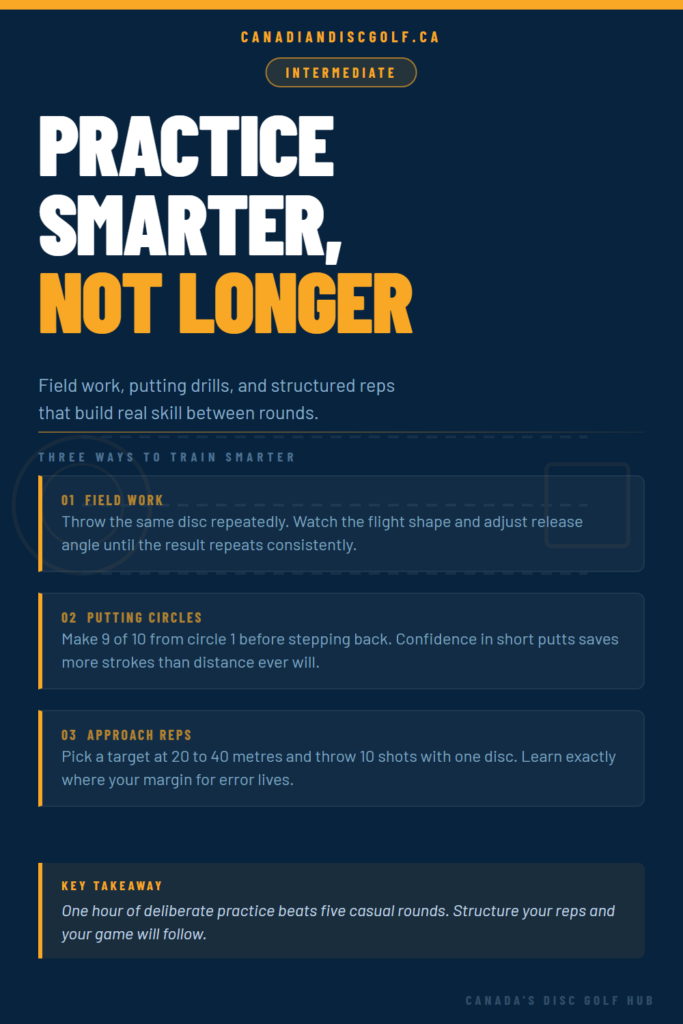
Start with one mid-range and a clear target, a bag, a cone, even just a patch of grass you’ve mentally designated as the landing zone. Throw ten shots at it with the same release angle. Every time. Watch what the disc does at the end of its flight. Does it fade hard left on every rep? Does it turn over and never come back? Does the result change randomly between throws? That flight shape is giving you direct feedback about your release, your angle, and whether that disc even matches your arm speed.
This is where understanding flight numbers starts to feel genuinely useful rather than just theoretical. When you can see the disc doing something specific in the air, rolling hard over or fading out sooner than expected, and you can connect that behaviour to what the numbers were predicting, you stop guessing and start calibrating. A disc rated with high turn and low fade will behave very differently at sixty percent power versus ninety. Watching that happen in a controlled setting, deliberately, is how you develop the internal reference library that better players have built over years without ever consciously naming it.
Once you’re getting consistent results with one disc, pick another. Compare the flight shapes from the same release to the same target. Now try a fairway driver on the same line. Watch what changes. You’re building an understanding of how your arm translates to flight across different molds, which is something that takes most recreational players ages to develop simply because they never slow down long enough to look.
A word on reps: quality beats quantity here, but quantity still matters. Sixty intentional throws in a focused hour will do more for your game than sixty holes of casual play. Not because casual rounds have no value, they absolutely do, but because field work is the only place you get to repeat the exact same scenario immediately and observe the variance.
Putting: The Discipline That Actually Saves Strokes
Putting is where rounds are won or lost, and where most amateur players bleed strokes they don’t even notice. A missed four-metre putt costs exactly one stroke. Same as a 300-foot drive into the woods. The difference is the putt was preventable.
Putting practice done right is, honestly, a bit boring. It demands repetition at short distances. There’s no drama, no distance, no satisfying whoosh. There’s a reason the field is always full and the practice basket is usually empty.
Start at three metres. Throw five putts focused entirely on your release motion, not on the result. Same grip, same push, same follow-through every time. The basket almost doesn’t matter yet. What you’re doing is wiring a repeatable movement into your muscle memory before you ask it to perform under any kind of pressure.
When you’re making eight or nine of ten from three metres without thinking about it, move back to five. Then to seven. Then circle one, which is roughly ten metres out. Don’t rush this progression. A lot of players sprint to longer distances because it feels more impressive, but you’re building a skill, not auditioning for anything.
Set up a clock drill around the basket: six putts from the north, six from the south, east, west, and the diagonals. Track your makes, even just a rough count in your head. Come back next week and run the same drill. Over time, the number climbs. That’s the feedback loop working. Short-putt confidence is one of the fastest ways to lower your scores because, unlike driving distance, it’s almost entirely a function of repetition and focus rather than raw athleticism.
Approach Shots: The Neglected Middle Game
Something odd happens in the space between a drive and a putt. Golfers pay huge attention to both but sort of sleepwalk through the approach, which is often the shot that determines whether you’re putting for birdie or scrambling for par. If your scramble game is weak, you already know what to fix.
A focused approach session looks like this. Pick a distance you’re genuinely inconsistent at, probably somewhere between twenty and forty metres, and set up ten discs. Throw every one of them at the same target with the same disc, and instead of aiming vaguely at the basket, pick a specific landing spot on the ground and try to hit it. This kind of precision focus, a landing zone rather than the basket itself, is what separates approach practice from throwing practice.
This is also the right context to work on the forehand shot if you’ve been neglecting it. A lot of players default to backhand for everything because it’s dominant and comfortable, but a reliable forehand approach opens angles that aren’t available otherwise. Throwing at the same target from the same distance with both releases, watching how the flight shapes differ and where each disc leaves you relative to the basket, builds the kind of balanced short game that makes putting feel much easier.
After ten throws at one distance, move. Forty metres. Twenty-five. Come at the target from the left side, the right side, over an imaginary obstacle. You’re not playing a hole. You’re stress-testing a set of shots in different configurations so that on-course, none of it feels new.
The Mental Side of Practice That Casual Rounds Can’t Give You
In a regular round, bad shots get forgotten quickly because they have to. There are people waiting, there are more holes ahead, and you’re supposed to be having fun. That pattern, throw it bad and move on, can quietly become a habit that prevents you from ever understanding why bad shots happen.
Practice sessions remove that constraint. When you throw five bad shots in a row in the field, you can stop. You can reset your grip, think about your footwork, breathe, and throw again with purpose. You can ask what changed. Your step timing? The angle at release? Your grip pressure? Most of the time, one thing changed, and if you find it, you’ve just learned something a casual round never would have surfaced.
This is also where honest self-assessment lives. You might discover your backhand is genuinely consistent but your forehand falls apart past fifteen metres. You might realize your circle one putting is solid but you’re losing everything from seven to ten metres, right in the anxiety zone between the comfortable short range and the low-expectation long range. These are fixable problems. But you have to practice in a way that reveals them first.
Building a Practice Habit That Sticks
A 60-minute structure that actually works: start with fifteen minutes of midrange field work at around thirty metres, focused entirely on release consistency. Warm the arm up with something controllable before you reach for drivers. Move to the basket for twenty minutes of putting, starting close and working outward, tracking your percentage even loosely. Finish with twenty-five minutes of approach reps from a few different distances and angles, mixing releases if you’ve been building both.
That’s it. No scorecard required, no group needed, no pressure to be entertaining. Just the work.
Before you leave, name one specific thing that got better. Out loud or in your head. If you genuinely can’t name anything, that’s feedback too, because it probably means the session wasn’t focused enough to produce a measurable result.
Repeat that loop a few times a week and the casual rounds you do play will start to feel different. Not magically easier, but cleaner. You’ll step into a putt at six metres and your body will know what to do because it has done it two hundred times in the last month. You’ll throw an approach from thirty metres and trust the result. You’ll read a fairway’s flight and have actual context for it.
The game starts to feel less like luck. That’s what deliberate practice buys you. And it turns out you don’t need a full round to get there.