
How to Throw a Forehand (The Sidearm Shot Explained)
Most players stumble onto the forehand by accident. Maybe they’re stymied behind a tree on the right side of the fairway and a backhand is physically impossible, so they flick something out there with a prayer and it actually goes reasonably straight. And then they think, huh, maybe I should actually learn this properly. That’s usually how it starts. Not from a tutorial. From desperation.
The forehand, or sidearm as it’s sometimes called, is genuinely worth developing deliberately. Not just as a rescue shot for awkward lies, but as a real weapon that opens up lines on the course a pure backhand player simply can’t access. Tight right-bending fairways, approaches from the right rough, skip shots into a basket positioned on the far right of a green. Having a reliable forehand doubles the number of lines available to you on almost every hole. It also tends to give you a flight shape that’s naturally more overstable than your backhand, which means it holds a fade and fights turn in ways that are tactically useful even when you’re not stuck behind anything.
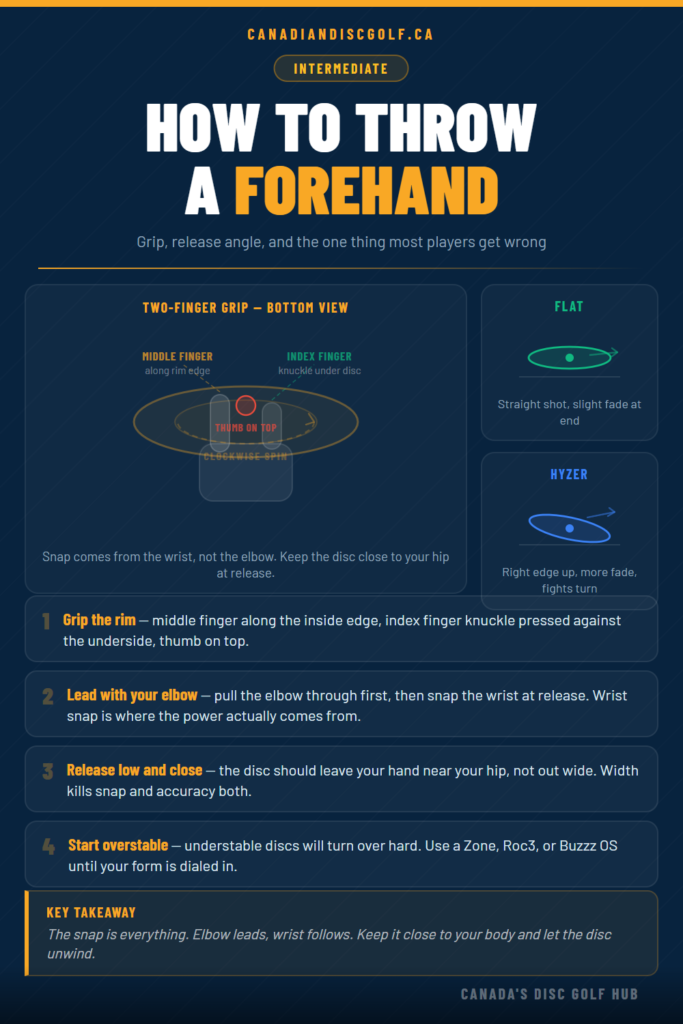
So. The grip first, because everything else flows from it. You want two fingers on the inside of the rim: your middle finger runs along the rim edge (not curled under, along the edge itself), and your index finger’s knuckle presses flat against the underside of the disc. Thumb goes on top of the flight plate. That’s the power grip, and it’s what most players use for distance forehand throws. Some players prefer a fan grip with fingers spread wider, which gives more control at shorter distances but less snap for bigger shots. Start with the power grip and adjust from there once you have some feel for it.
The motion itself is where most beginners go badly wrong, and it’s worth reading our breakdown of why your driver isn’t going far alongside this, because some of the same mechanical mistakes show up in both throws. The single biggest forehand error is leading with the wrist instead of the elbow. It feels like it should generate more snap, but it actually kills power and causes the disc to release early and wide. What you want is to lead with the elbow, dragging it through toward the target first, and then let the wrist snap at the very end of the motion. The wrist snap is where the spin and the speed actually come from. The rest of the arm just positions the wrist to fire correctly.
Keep the disc close to your body throughout the motion. Really close. It should brush past your hip at the point of release, not swing wide out to the side. Width is the enemy of forehand snap. When the disc is out wide, you lose leverage, you lose spin, and the release angle gets unpredictable. Inside and low. Every time.
Disc selection matters a lot when you’re learning this. Understable discs are brutal for forehand throws because the natural spin direction of a forehand (clockwise for right-handers) already wants to turn the disc right. An understable disc amplifies that massively and you end up watching it roll into the brush every time. Start with something overstable: the Discraft Zone is a classic forehand learning disc, the Buzzz OS works well, the Innova Roc3 is another good option. These discs resist the turn, fly a reasonably straight line with that natural forehand fade at the end, and they’re forgiving enough that imperfect form doesn’t result in a complete disaster every throw.
Once the basic form feels repeatable, start experimenting with release angle. A flat release produces a fairly straight flight with a reliable fade. A forehand hyzer (right edge of the disc up at release, for right-handers) produces more fade and is excellent for shots that need to curve right to left. Anhyzer forehand is an advanced shot that takes a long time to control consistently. Leave it alone until flat and hyzer feel automatic.
Expect a few frustrating rounds while this develops. The forehand engages muscles and wrist mechanics that most people haven’t specifically trained. Soreness in the forearm and wrist is normal at first. Don’t throw through pain, and don’t try to max out distance before the form is actually there. Short, controlled throws first. The distance comes later, after the snap does.
It’s a grind. But the players who put in the work on their forehand are genuinely more complete disc golfers for it.