
Disc Golf Shoes & Footwear: Why It Matters & What to Actually Look For
Most new players don’t think about shoes until they slip on a wet tee pad or turn an ankle on a root-covered fairway. Then it becomes obvious pretty fast. Disc golf is a walking sport played almost entirely on unmanicured terrain, and the ground underfoot changes constantly within a single round. Concrete tee pads, wet grass, muddy slopes, pine needle-covered paths, exposed roots, gravel. Whatever shoes you’re wearing need to handle all of it.
The good news is that disc golf shoes don’t need to be expensive or specialized. The bad news is that regular running shoes — which is what most people show up wearing — are often the worst choice for the specific demands of the sport.
Why running shoes don’t work
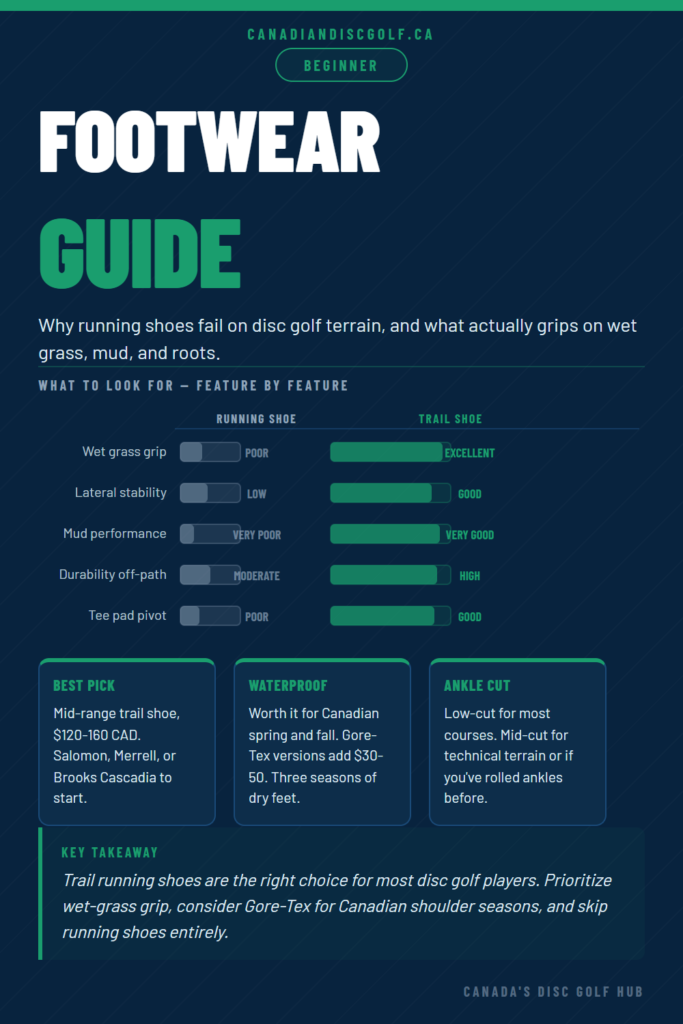
Running shoes are built for forward motion on relatively flat, predictable surfaces. The grip patterns on the outsole are designed to push off straight ahead. Lateral stability is minimal because running doesn’t require much side-to-side movement.
Disc golf requires lateral movement constantly. You’re stepping around obstacles, planting on uneven ground, pivoting on the tee pad, and walking across slopes at awkward angles. A running shoe that rolls or slides during a planted pivot is actively hurting your throw and creating injury risk on the tee pad. The smooth foam midsole that makes running shoes comfortable on pavement becomes a liability on wet grass.
Flat-soled sneakers and casual shoes are even worse. No grip pattern at all means any moisture on any surface turns into a skating rink.
What actually works: trail running shoes
Trail running shoes are the most practical choice for the majority of disc golf players. They’re built for exactly the kind of terrain disc golf happens on. Aggressive grip patterns on the outsole handle wet grass, mud, and loose ground. The upper materials are generally more durable than road running shoes. Most are low-profile enough that they don’t interfere with your natural throwing motion.
Brands like Salomon, Merrell, Brooks Cascadia, and Hoka Speedgoat all make trail shoes in the $120 to $180 CAD range that will last multiple seasons of regular play. The Salomon Speedcross series in particular has developed a genuine following in the disc golf community for its aggressive lug pattern and reliable wet-grass traction.
You don’t need a disc-golf-specific trail shoe. The crossover from hiking and trail running is near-complete. If a shoe grips on wet roots and loose dirt, it grips on a disc golf course.
Waterproofing: when it’s worth it
Waterproof footwear adds cost and reduces breathability. Whether it’s worth it depends almost entirely on where and when you play.
In Canada, the answer for most players is yes, at least for part of the year. Spring rounds mean morning dew on every fairway. Fall rounds mean soggy ground from October onward. Winter disc golf, for the players who keep playing year-round, means conditions that destroy non-waterproof shoes within a few holes. If you’re playing through Canadian fall and shoulder seasons, waterproof trail shoes are the obvious call. Your feet stay dry, your grip stays reliable, and you’re not cutting rounds short because your socks are soaked through by hole six.
For summer-only players on well-maintained courses, waterproofing matters less. Breathability becomes more valuable in warm weather, and standard trail shoes handle summer conditions without the extra layer.
Gore-Tex versions of most trail shoe lines exist and add roughly $30 to $50 to the price. Worth it for three-season Canadian play. The cold weather article covers footwear briefly in that specific context as well if you’re planning to play through winter.
Ankle support and what terrain demands it
Low-cut trail shoes cover most courses fine. They’re lighter, more flexible, and let you move naturally on flat to moderately technical terrain.
Mid-cut or high-cut options make sense if your home course has significant elevation changes, loose or rocky terrain, or lots of root-covered fairways where rolled ankles are a realistic risk. This is more relevant to players in BC, northern Ontario, or any region where courses are built on genuinely technical terrain rather than municipal parks. If you’ve rolled an ankle on a disc golf course before, a mid-cut shoe is cheap insurance.
Disc golf rarely demands the full ankle lockdown of a hiking boot. You’re moving too much for that to be comfortable over eighteen holes. The sweet spot for most players is a low-cut trail shoe on flat to moderate terrain, mid-cut for anything technical.
Cleats and metal spikes: worth it?
Disc golf cleats exist and are legal in most casual rounds. They grip exceptionally well on wet grass and muddy tee pads. They’re also louder, heavier, and less comfortable for extended walking than trail shoes.
For competitive players in wet conditions, cleats are worth considering for traction on tee pads specifically. For recreational players covering four to six kilometres of walking per round, the comfort trade-off against a good trail shoe isn’t worth it. Trail shoes with aggressive lug patterns cover ninety percent of what cleats offer without the drawbacks.
Metal spikes are overkill for disc golf and can damage some tee pad surfaces. Soft rubber cleats or molded plastic studs are the appropriate choice if you’re going that route.
The practical buying guide
If you’re starting from nothing: buy a mid-range trail running shoe in the $120 to $160 CAD range. Salomon, Merrell, or Brooks are all reliable starting points. Try them on with the socks you actually play in. Check that there’s enough room in the toe box that your toes aren’t compressed on downhill slopes.
If you already have trail shoes that work: you probably don’t need to buy anything specifically for disc golf. Play a few rounds and see if traction or waterproofing becomes a problem. Buy for the problem you actually have.
If you play year-round in Canada: Gore-Tex trail shoes are the single best footwear investment for disc golf, full stop. One pair that handles spring mud, summer trails, fall sogginess, and light snow is more practical than switching between multiple pairs.
The shoes matter. Not as much as the discs, not as much as the form. But a slip on a wet tee pad costs you a throw, and a turned ankle costs you a round. Getting this right once is worth it.