
Disc Golf Bags Explained: Starter Bags, Backpacks, Carts & What to Actually Buy
The bag you carry matters less than the discs inside it, right up until the bag starts causing problems. Straps digging into your shoulder by hole six, no room for a water bottle, discs falling out every time you bend over to mark your lie. The wrong bag is a minor annoyance that compounds across every round you play. Getting this right once is worth the thirty minutes of research.
There are three main categories: starter bags, backpacks, and carts. Each makes sense for a specific type of player. None of them is universally correct.
Starter bags and sling bags
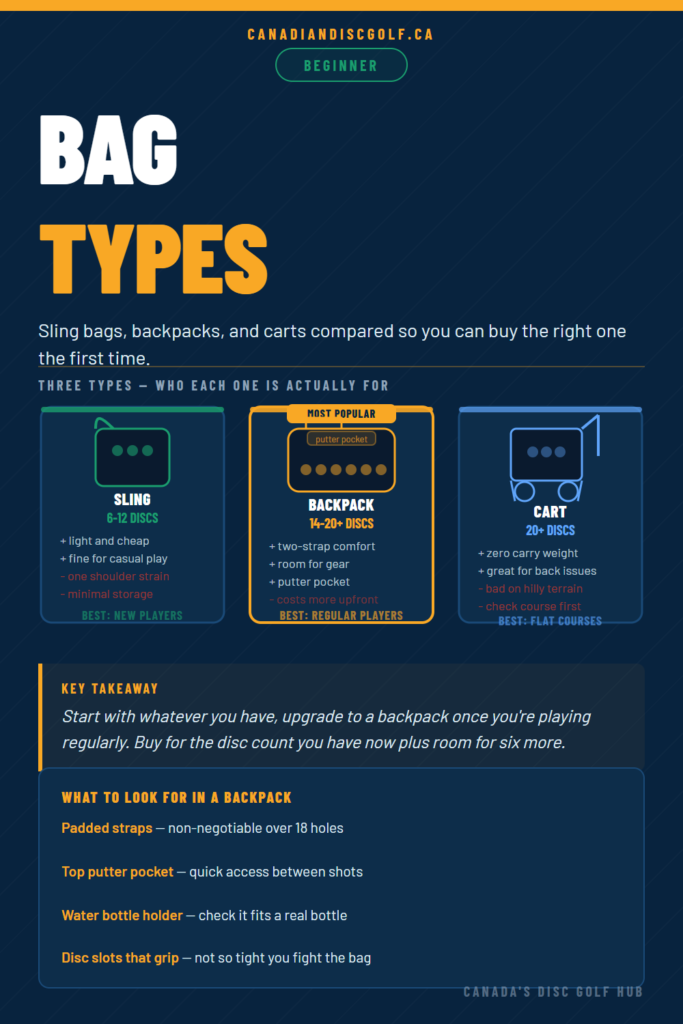
A starter bag or sling bag is exactly what it sounds like. One strap, hangs off one shoulder, holds somewhere between six and twelve discs depending on the model. Most disc golf starter sets come bundled with one. They’re light, cheap, and fine for what they are.
The honest case for a sling bag: if you’re brand new to disc golf and not sure how often you’ll play, a sling bag lets you carry what you need without spending money on a backpack you might not use. They’re also legitimately convenient for short casual rounds where you know you’re only throwing five or six discs.
The limitations show up quickly for anyone playing regularly. One-shoulder carry gets uncomfortable on longer courses, especially with a full bag. Storage is minimal beyond disc slots. There’s usually nowhere to put a rain jacket, a snack, or a phone that isn’t stuffed into a disc slot. Once you’re playing more than once a week or carrying more than eight discs, a sling bag starts working against you.
Canadian retailers carrying sling options include most Sport Chek locations that stock disc golf, along with online options through Discgolf.ca and the Canadian Disc Golf store. Infinite Discs ships to Canada and tends to have better selection than most domestic options, though shipping costs add up.
Backpack bags
The backpack is where most recreational players end up within their first season, and for good reason. Two straps distribute weight across both shoulders, which makes a real difference over eighteen holes on a hilly course. Disc capacity typically runs from fourteen to twenty-plus discs depending on the model. Storage pockets for water, valuables, rain gear, and snacks are standard. Many models have a dedicated putter pocket on top for quick access.
The range of quality and price here is wide. Entry-level disc golf backpacks from brands like Dynamic Discs, Latitude 64, and Innova run roughly $60 to $100 CAD and are perfectly functional. Mid-range options from Grip EQ, Prodigy, and Axiom in the $120 to $200 range add better padding, more organization, and build quality that holds up over years of use. Premium bags from Grip EQ and Discmania can push past $300, which is hard to justify unless you’re playing competitively or just genuinely want a bag that lasts a decade.
For most players starting to build a real bag, the Dynamic Discs Trooper or Commander gives you what you need at an honest price. The Latitude 64 Swift is another solid mid-range option that Canadian players can usually find domestically.
What to look for specifically: padded shoulder straps (non-negotiable for comfort on longer rounds), a dedicated top putter pocket, a water bottle holder that actually fits a standard bottle, and disc slots that grip without being so tight that you’re wrestling with your bag between shots.
Building out what goes inside is a separate question, and the disc golf bag on a budget article covers that specifically if you’re starting from scratch or filling gaps.
Carts
A cart is a push or pull trolley that holds your bag or a specialized cart bag, freeing you from carrying any weight at all. They’re common in traditional ball golf and increasingly common in disc golf, particularly among players with back issues, older players, or anyone playing longer or more technical courses regularly.
The practical argument for a cart is straightforward: you can carry more discs, more water, more gear, and more snacks without your body paying for it by hole fifteen. Some carts fold small enough to fit in a car trunk easily. Others are bulkier. That’s worth checking before you buy.
The limitations in disc golf specifically are course-related. Many disc golf courses have narrow paths, significant elevation changes, muddy sections in spring and fall, or terrain that a wheeled cart genuinely cannot navigate. A cart that’s great at a flat, well-maintained municipal course is a liability on a wooded hilly course with tight fairway corridors. Know your home course before committing to one.
Carts also change the social dynamic of a round slightly. You’re not walking freely with the group in the same way. It’s a minor thing, but worth thinking about if you play with a regular group where pace matters.
MVP and Prodigy both make disc golf-specific carts worth looking at. Standard ball golf push carts can also work if you have a backpack bag with appropriate attachment points, which is a cheaper entry point if you already own a backpack bag.
The actual decision
Most new players should start with whatever bag came with their starter set, play enough rounds to know how often they’re going to play, and then buy a mid-range backpack once they’ve outgrown the sling. That’s the sensible path for the majority of people.
If your back or shoulders are already a concern, go straight to a backpack with good padding or research carts from the start. The money saved by toughing it out with a one-strap bag is not worth a round that ends early because your shoulder is shot.
Buy the bag after you’ve figured out the discs, not before. The discs you need determine the capacity you need, and capacity determines which bag makes sense. A six-disc collection doesn’t need a twenty-disc backpack. A fifteen-disc bag that’s actually dialled in absolutely does.