
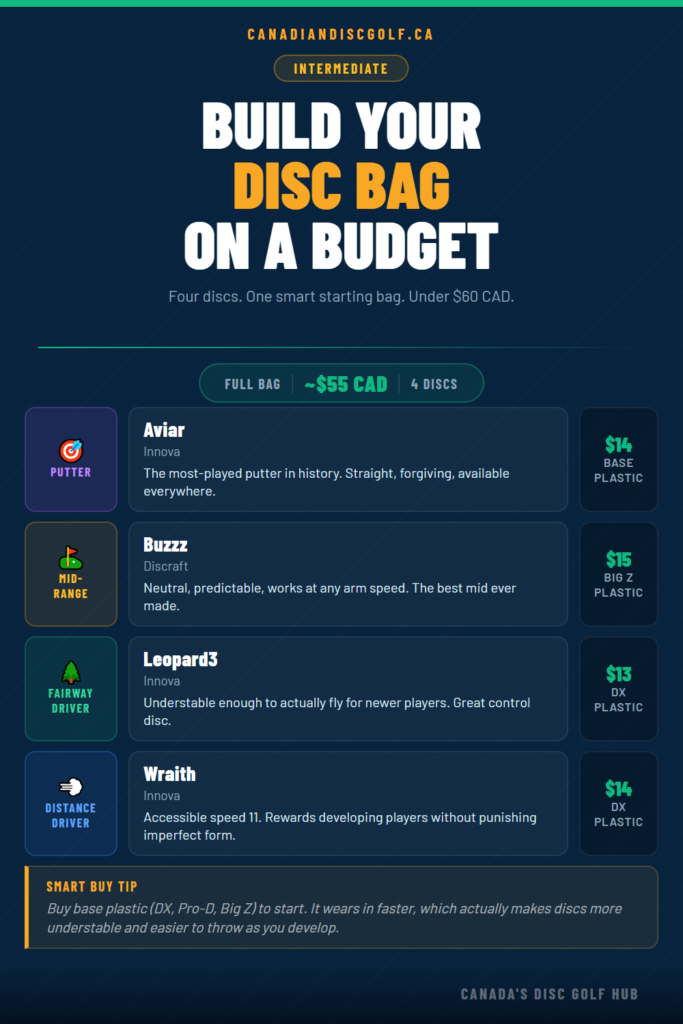
How to Build a Disc Golf Bag on a Budget
Walk into any disc golf shop and the wall of plastic is genuinely overwhelming. Dozens of brands, hundreds of models, price tags ranging from twelve dollars to thirty-five, and roughly zero guidance on which ones actually matter for someone still figuring out their form. Most new players end up buying four or five discs based on nothing more than the graphic or the name, throwing them a few times, and then wondering why none of them fly the way the description said they would. It’s an expensive and frustrating way to start.
The good news is that building a functional, well-rounded disc bag doesn’t require spending a lot of money. It requires spending it in the right places. Four discs, chosen deliberately, will cover every situation a developing player encounters on a standard course. Here’s how to think about it.
Start with a putter, because putters are the most underrated purchase in disc golf and the most neglected slot in a beginner’s bag. Most new players grab one putter, use it only at the basket, and ignore the fact that a putter is actually the most controllable disc in your bag for any shot under about 50 metres. The Innova Aviar has been the best-selling putter in the world for decades for a reason. It’s straight, forgiving on release, available at basically every shop and online retailer in Canada, and costs around fourteen dollars in base DX plastic. Buy two if you can. Use one for putting practice at home and one on the course.
For a midrange, the Discraft Buzzz is the honest answer for almost everyone. It’s neutral, meaning it doesn’t aggressively turn right or fade hard left at most arm speeds, it has a comfortable feel in the hand, and it rewards decent form without punishing imperfect form too harshly. The most popular midrange disc ever made, and for good reason. Around fifteen dollars in Big Z plastic, which is durable enough to last a full season of regular play. If you want a more detailed breakdown of which discs work at each skill level, the guide to best discs for beginners covers this in depth and is worth reading alongside this.
A fairway driver should be your third purchase, and this is where most people make their first big mistake. They grab a speed 11 or 12 driver because it says “distance” on the packaging and then throw it at sixty percent of the speed it needs to actually fly properly. Understable fairway drivers are the right call for developing players. The Innova Leopard3 is the standard recommendation here, speed 7, understable enough to actually turn over and fly when thrown at realistic arm speeds. It costs about thirteen dollars in DX plastic and will do more for your distance development than any speed 13 driver you could buy at twice the price.
The fourth slot is a distance driver, and the advice here is similar: don’t reach for maximum speed. The Innova Wraith at speed 11 is accessible enough to reward improving players without being a completely dead disc in less experienced hands. It’s slightly understable, glides well, and the DX plastic version runs around fourteen dollars. That’s a full four-disc bag for roughly fifty-five dollars Canadian. Compare that to the cost of buying five random discs because the graphics looked cool, and the math is obvious.
One more thing worth knowing about plastic grades. Base plastic, which is DX from Innova, Pro-D from Discraft, and similar entry grades from other brands, wears in over time. The plastic softens and the disc becomes more understable as it takes hits on trees and concrete. For new players this is actually a feature, not a bug. A worn-in DX Aviar or DX Leopard3 becomes easier to throw well as the plastic breaks down. Premium plastics like Champion or Star hold their flight characteristics longer, which is great when you’re advanced enough to throw a disc consistently, but less useful when you’re still developing the form that makes consistency possible.
The bag above will serve you through your first season and well into your second. Resist the urge to keep buying. More discs don’t fix form problems. They just give you more ways to throw badly.