
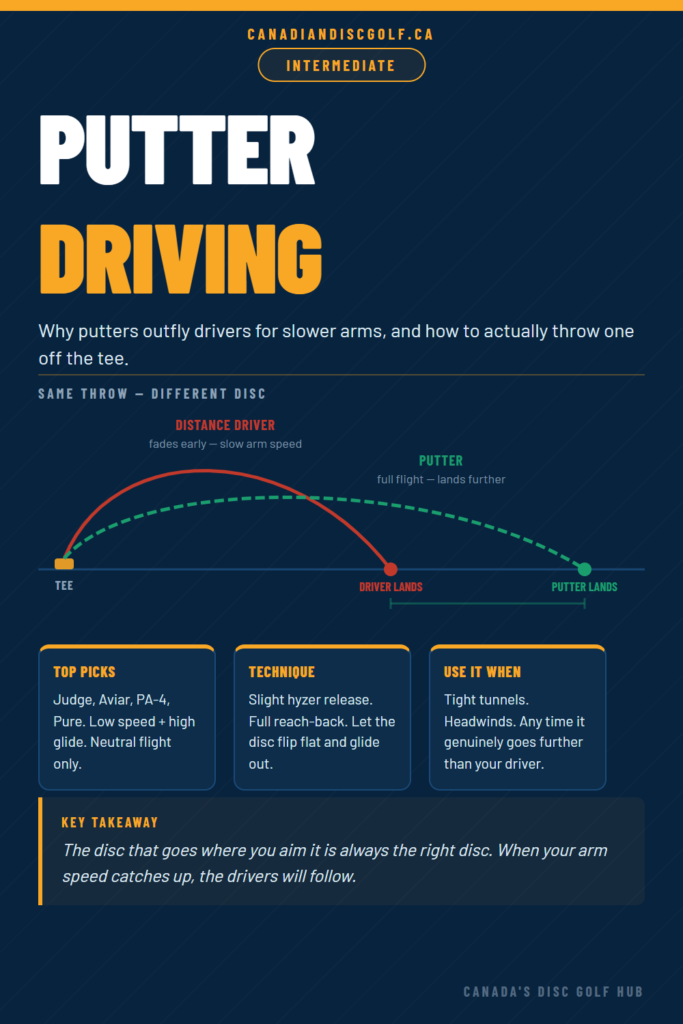
Putter Driving Explained: Why Putters Go Further Than Drivers for Many Players
Most newcomers reach straight for the fastest disc in the bag. They heave a distance driver as hard as they can and watch it dump into the ground at 150 feet. Then someone nearby pulls out what looks like a Frisbee and sails it 250 feet down the fairway without breaking a sweat. That disc was a putter. And what just happened wasn’t some trick shot.
Speed ratings aren’t suggestions. They tell you the arm speed a disc needs to fly the way it was designed. The Innova Destroyer is rated Speed 12. Throw it below that threshold and it gets overstable — it dumps left (for right-handed backhand throwers) before you get any real distance out of it. Not because you threw it wrong, necessarily. Because the disc was built for an arm speed you don’t have yet, and it’s just doing what discs do when they’re thrown too slow.
A putter rated Speed 2 or 3 is designed for a much slower throw. Your natural arm speed is the arm speed it actually wants. The disc goes where you point it. The glide kicks in. You use the whole flight path instead of fighting the disc halfway there.
If you’ve been grinding on a driver that just won’t cooperate, the piece on why your driver isn’t going far breaks down the specific reasons this happens, in detail. Worth a read before you buy anything new.
Which putters actually work off the tee
Not every putter is built for this. You want something with decent glide and a neutral to slightly understable flight. Heavy overstable putters like the Discraft Zone or Kastaplast Berg drop straight down and won’t give you distance off the tee. You need something that rides.
The Dynamic Discs Judge is probably the most common driving putter at the recreational level. Speed 2, Glide 4, Turn 0, Fade 1. Goes straight. Goes where you aim it. Forgives off-center releases better than almost any driver will. Plenty of players bag two: one dedicated to putting, one for the tee pad on shorter, tighter holes.
The Innova Aviar has been doing this same job for decades. Nothing fancy about it. Just reliable, and reliable is what you actually need when you’re trying to score.
For players who want a bit of turn to work with — longer anhyzer lines, hyzerflip shots — the Prodigy PA-4 or the Latitude 64 Pure give you something with movement without going sideways. The Discraft Comet is technically a midrange, but it flies so much like a putter-class disc on slower arms that it deserves a mention here. Understable, glidy, very forgiving.
The technique isn’t “putt harder”
This is where people go wrong. Putter driving is not scaled-up putting. It’s actual driving, just with a putter in your hand. Full reach-back. Hips leading. Proper weight transfer through the motion. The same mechanics you’d use throwing any other disc off the tee.
Grip usually stays the same. Power grip or fan grip, whatever you’re comfortable with. Some players switch to a full power grip for extra security at higher throw speeds, but it’s not required.
Hyzer angle is probably the biggest single variable for getting the most out of a putter drive. Throwing on a slight hyzer — disc tilted down on the outside edge at release — causes the disc to flip up flat, ride the glide, and fade gently at the end. That’s the flight path you’re after. When someone makes it look effortless, this is usually why: the disc is just doing exactly what a slow-speed disc does on a hyzer release. Throwing flat tends to waste the glide. Throwing anhyzer from the start risks the disc going sideways.
A run-up helps, even if it’s just a couple of walking approach steps. Standing flat-footed is leaving distance on the table. You don’t need a full X-step right away, but some lower-body momentum makes a real difference.
One more thing: commit. Tentative throws kill distance more than anything else. A player who fully rips a Judge with confidence will almost always out-throw someone who grips a Destroyer and mentally second-guesses it the whole way.
When to actually reach for it
Tight tunnels, first and foremost. If there’s a gap between trees you need to thread, a putter’s predictable straight-to-gentle-fade flight is usually the safer choice over a fairway driver that might exit the gap at the wrong angle. You know what it’s going to do. That matters.
Into a headwind. High-glide discs get punished badly in headwinds. A putter with less glide punches through considerably better, and you can throw it low and flat without the disc stalling out. Experienced players make this switch all the time because the disc just stays in control when conditions get rough.
Low-ceiling holes. Getting a putter under a canopy on a flat, low release beats fighting a fairway driver through branches. Bump-and-run shots also work well with a putter’s predictable behavior on the ground.
And, of course: any situation where you know the putter goes further. This should be obvious, but it often gets ignored for ego reasons.
When to keep it in the bag
Tailwinds on wide-open fairways usually favor a proper driver, assuming you have one that fits your arm speed. A tailwind with an understable putter can flip the disc completely and send it way off-line. That’s a bad miss on a hole that should be straightforward.
There’s also a natural distance ceiling with any putter. No matter how much arm speed you put behind a Speed 2 disc, it eventually tops out. Once your throw genuinely outgrows it, the putter stops giving you more. You’ll feel when that happens — the drivers start doing what they’re supposed to do, and putter driving becomes a specific-situation tool rather than your go-to move.
If your drivers are already cooperating? Great. This whole conversation isn’t really for you.
The honest version of this
If you’re throwing a putter 240 feet and a driver 180 feet, throw the putter. On most holes. The scorecard does not care which disc you used to get the disc on the green.
A lot of players stay in the driver phase way too long. Grinding through bad results because they feel like they’re supposed to be throwing a driver. Meanwhile, the same player throwing a Judge down the middle of every fairway would probably shoot five or six strokes better. That’s not a small number.
The disc that goes where you aim it is always the right disc. When your arm actually catches up — and it will, if you keep playing and working on your form — the drivers will start cooperating. You’ll notice the difference. Until then, put a Judge or an Aviar in your bag and actually use it on the holes where it makes sense. What happens to your score might surprise you.