
How Discs Change as They Wear In: What Seasoning Means for Your Game
Your disc is not the same disc it was six months ago. If you’ve been throwing it regularly, hitting trees, skipping it off cart paths and frozen ground, the flight has changed. Maybe subtly, maybe dramatically, depending on what plastic it’s made of and how hard life has been on the rim. This process has a name in disc golf circles: seasoning.
Understanding it isn’t just trivia. It changes how you buy discs, how you bag them, and how you troubleshoot shots that used to work and don’t anymore.
What Actually Happens to a Disc
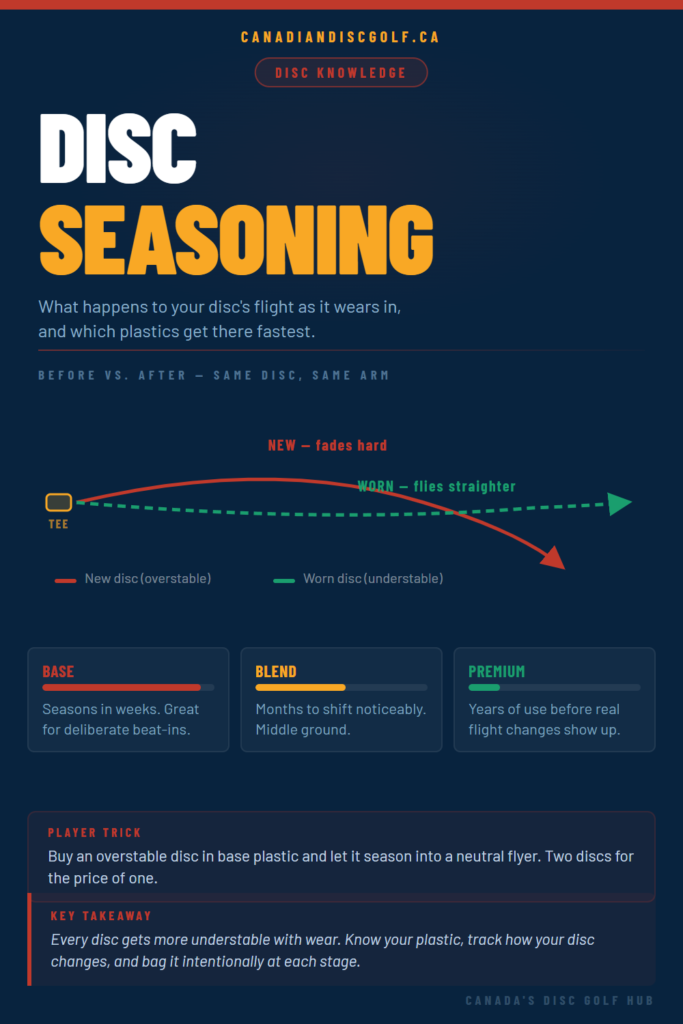
The rim takes the most punishment. Every tree hit, every skip off hard ground, every rock contact chips and deforms the rim slightly. That edge is what cuts through the air and generates the disc’s stability. As it wears down and softens, the disc loses fade and gains turn. An overstable fairway driver that reliably finished left at the end of its flight might, after a full season of hard use, fly significantly straighter or even turn over at the same power level.
This shift is always in the same direction: toward understable. A disc cannot become more overstable through wear. It starts at its rated stability and drifts understable from there, at a pace entirely determined by plastic type and how hard it’s being thrown into things.
Seasoning Speed by Plastic
Base plastics, like Innova DX or Discraft Pro-D, season fast. A few rounds into trees or a handful of hard skips on pavement can produce a noticeable flight change within a single season. For some players this is a problem. For others it’s a feature: you can intentionally take an overstable base plastic disc and let it season into a neutral flyer, effectively getting two usable flight profiles out of one disc over its life.
Premium plastics like Star, Champion, and Z resist wear much more stubbornly. The harder material holds the rim’s shape through contact that would noticeably deform a base plastic disc. A premium fairway driver thrown regularly for two or three seasons might show only minor stability shifts. This is why most serious players keep premium plastic in slots where consistency matters most, particularly distance drivers and workhorse fairway discs they’ve spent real time calibrating.
Blend plastics sit predictably in the middle. The Discraft Buzzz OS in ESP plastic, for instance, will season noticeably faster than the Z version of the same mold, but considerably slower than the Pro-D version. If you own both, you can watch the gap between them narrow over a season as the ESP drifts toward where the Z already sits.
Why Seasoned Discs Are Valuable
There’s a reason tour players keep beat-in discs in their bags alongside brand new ones. A seasoned premium plastic disc that has drifted from overstable to neutral gives you a predictable, tested flight shape that a new understable disc off the shelf doesn’t. You know exactly how it behaves across a range of power levels because you’ve thrown it hundreds of times. That comfort is worth something, especially under pressure.
The Innova Leopard is a classic example. New in Star plastic it’s already understable. After significant wear it can become a roller or hyzerflip machine. Players who want that flight profile and don’t want to wait will deliberately buy the DX version and let it season quickly. Players who want the slower drift buy Star and enjoy the ride.
How to Track Your Discs
The practical issue is that seasoning is gradual enough that you often don’t notice it until the disc is doing something significantly different from what you expect. A disc that used to finish reliably left now flies straight. You adjust your aim, compensate slightly, and eventually the disc is too understable to throw the way you want it to.
A simple habit that helps: when you buy a disc, note the date and its initial flight tendencies somewhere, even a short note in your phone. Every few months, throw ten reps at a familiar target and compare the result to what you remember. You’ll catch the drift before it becomes a problem rather than troubleshooting it mid-round. This pairs naturally with how plastic types affect flight in the first place. Once you understand both, you’re buying and managing discs as a system rather than just accumulating them.
Building a Bag Around the Wear Cycle
The most intentional disc golfers think about seasoning when they build their bags. They buy a new premium version of a workhorse disc while the old one is still usable but starting to drift, so the new one can season in while the old one still has a role. When the old disc becomes too understable for its original slot, it gets moved to a different role or retired. Nothing gets thrown away before its time.
This approach keeps your bag stable even though the individual discs in it are always slowly changing. It also means you’re rarely caught without something that flies the way you need it to.