
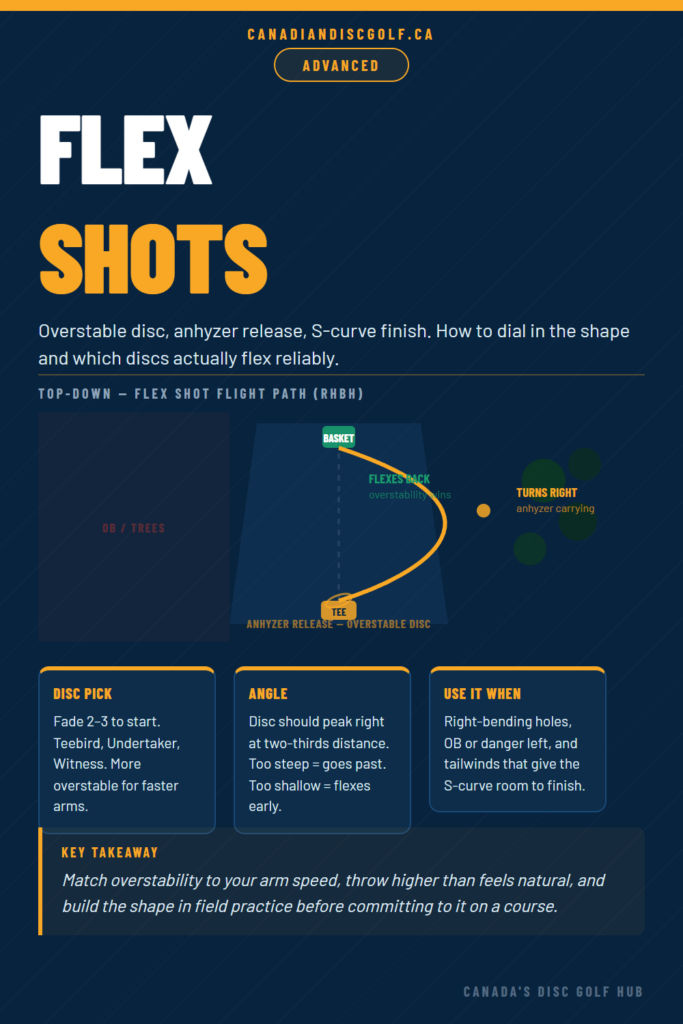
Disc Selection for Flex Shots: How to Shape the Right-to-Left S-Curve on Demand
The flex shot is one of those things that looks like showing off until you understand why it exists. Then it becomes a shot you wish you’d learned sooner, because there are holes, usually long, bending right-to-left, where it’s genuinely the most efficient line available. Not a trick. A tool.
The concept is straightforward enough. You throw an overstable disc on an anhyzer release angle. The disc turns right under the anhyzer, carries out to the right side of the fairway, and then the disc’s overstability kicks in and flexes it back left, finishing toward the target in an S-curve. Executed correctly, the disc covers a lot of ground and ends up exactly where you aimed, just via a route that looks nothing like the direct line from the tee.
What makes it Advanced isn’t the concept. It’s the combination of factors you have to calibrate simultaneously: disc stability, release angle, throw speed, and the height of the anhyzer. Get one of those wrong and the shot goes to a completely different place than intended.
Why disc selection is the foundation
The flex shot only works with an overstable disc. That’s not a style preference — it’s physics. You need a disc that will resist the anhyzer long enough to carry right, then overpower it and flex back. An understable disc thrown on anhyzer just turns and keeps turning. A neutral disc might flex back weakly but won’t give you a reliable, repeatable finish. You need actual fade built into the disc.
How much overstability you need depends on how hard you throw and how severe the anhyzer angle is. Slower arm speeds need less overstable discs for flex shots because the disc doesn’t have enough speed to resist a highly overstable mold before it flexes too early. Faster arm speeds can handle, and often need, more overstable options to get the full turn before the flex kicks in.
A good starting point for most intermediate-to-advanced players: a fairway driver with fade of 2 to 3. The Innova Teebird is probably the most common flex shot disc at the recreational level. Predictable, consistent, and overstable enough to flex reliably without being so beefy that it needs maximum arm speed to turn at all. The Discraft Undertaker works similarly. The Dynamic Discs Witness is another option that flexes cleanly for players with moderate arm speed.
For stronger arms, the Innova Firebird or Discraft Force give you the extra fade that prevents the disc from just flying straight on anhyzer rather than turning and coming back. Distance drivers with high fade can be flexed too, the hyzerflip and the flex shot are genuinely mirror images of each other, one understable on hyzer, one overstable on anhyzer, but control gets harder as disc speed increases, so work up to those.
The release angle and height
The anhyzer angle controls how far right the disc goes before it flexes. A gentle anhyzer means a subtle right curve before the fade takes over. A steep anhyzer sends the disc further right and requires a longer flight path before the flex kicks in. Most flex shot problems come from the release being either too shallow (disc flexes back too early, barely clears left of center) or too steep (disc goes so far right it hasn’t started coming back by the time it hits the ground).
A useful calibration point: the disc should be roughly at its maximum rightward point when it’s about two-thirds of the way through its flight. If it’s turning right all the way to the landing zone, your anhyzer was too steep for that disc and throw speed. If it flexes back almost immediately after release, the anhyzer was too shallow.
Height matters for the same reason it matters on any long shot: altitude gives the disc time to complete its flight path. A flex shot thrown too low runs out of air before the flex finishes, landing right of where you wanted. Releasing slightly higher than you might on a flat throw gives the S-curve room to complete itself. This is counterintuitive for players who’ve been taught to throw low and flat for control, flex shots need altitude as a deliberate design element, not a mistake.
When to actually use it
The flex shot earns its place on long holes that bend right-to-left, especially when there’s something blocking the direct line. A tree line or OB on the left side of the fairway that makes a straight throw risky? A flex shot that curves out right and comes back hits the center of the fairway while clearing the left-side danger entirely. The shape does the work instead of thread-the-needle accuracy.
It’s also useful in tailwinds. A tailwind extends carry distance and gives the disc more time to complete its flight path, which means a flex shot can cover enormous ground. Some of the most impressive long-distance shots you’ll see at open courses are flex shots in a tailwind, the disc goes right, keeps going, and flexes back across the full width of a fairway before landing.
Headwinds are generally not the right time for flex shots. The wind cuts distance and accelerates how quickly the disc loses speed, meaning the fade can kick in too early and the disc flexes back before it’s covered the right-side ground you needed.
Building it into your bag, not just your trick shot rotation
The players who get the most out of flex shots treat them as a primary option on certain holes rather than a last resort when the direct line is blocked. That requires actually practicing the shape on an open field before committing to it on the course, because the feel of an anhyzer release at full throwing speed takes time to internalize. It doesn’t feel like your normal throw. The wrist angle is different. The disc position at release is different.
Field work suggestion: pick a disc you’re comfortable with in the fade-2 to fade-3 range, throw it on a progressively steeper anhyzer until you find the angle where it turns right and flexes back consistently. Note the feel of that release angle. That’s the rep you’re building. Once it’s repeatable in the field, you’ll start seeing flex shot lines on the course that weren’t visible to you before.