
Disc Golf in Provincial Parks & Public Land: Where It’s Allowed & How to Do It Right
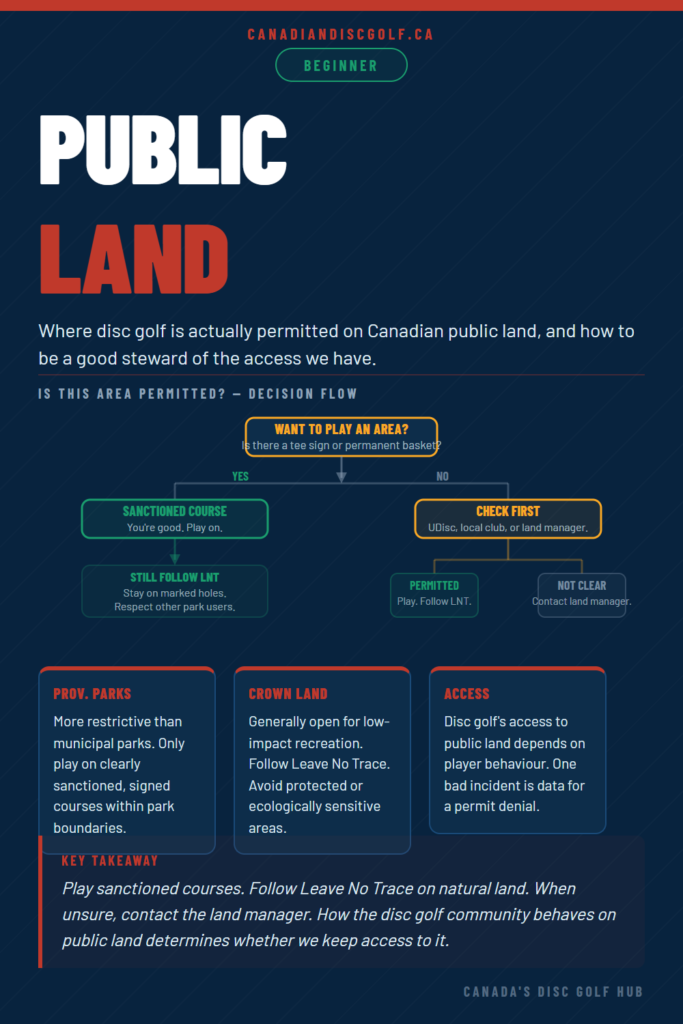
Disc golf is one of the cheapest outdoor sports in Canada, and one of the reasons for that is how much of the game happens on public land. Municipal parks, recreation areas, provincial campgrounds, and Crown land host courses across the country. Most players use these spaces without much thought about the rules that govern them, which is fine right up until it isn’t.Knowing where you’re actually allowed to play, and how to behave on land that belongs to everyone, is worth understanding before you wander into a protected area with a bag full of discs and no idea whether a course is sanctioned.Established courses versus self-directed playThe simplest situation is an established disc golf course on public land. These are courses that have been formally permitted by the land manager, whether that’s a municipality, provincial parks authority, or recreation area. Tee signs are up, baskets are permanent, and you have implicit permission to play simply by being there. This covers the majority of courses in Canada.Self-directed play is different. Throwing discs in a public park without an established course is a grayer area. In most urban municipal parks, casual throwing is permitted as long as you’re not creating a hazard for other park users. A few friends throwing approach shots in an open field is generally fine. Stringing a full eighteen-hole layout through a busy park without permission is not, and in some parks even casual throwing requires you to stay in designated open areas.Provincial parks are more restrictive as a general rule. Most provincial parks in Canada prohibit disc golf on unmarked trails and natural areas, regardless of whether a course exists. Where a sanctioned course exists within a provincial park, it’s usually clearly signed and limited to a specific area. Playing outside that area, even if the terrain looks ideal, puts you in violation of park rules and can result in fines.Crown land and backcountryCrown land covers an enormous portion of Canada and is generally open for low-impact recreational use. In practice, throwing discs on Crown land you’ve hiked into is unlikely to be a problem provided you’re following Leave No Trace principles and not damaging vegetation or wildlife habitat. There are no baskets and no established lines, but recreational disc throwing in open Crown land terrain is generally within the spirit of the access rights that apply.The exception is Crown land adjacent to or within protected areas, ecological reserves, or Indigenous traditional territories with specific access agreements. These areas can have restrictions that aren’t obvious from a map. If you’re unsure about a specific area, a quick check with the provincial natural resources or parks authority for that region takes five minutes and removes the ambiguity.Leave No Trace applied to disc golfLeave No Trace is a set of outdoor ethics principles that applies directly to disc golf on public land. The core ideas translate simply. Stay on established paths rather than cutting new ones through vegetation. Don’t disturb wildlife, especially during nesting and breeding seasons in spring. Pack out everything you bring in, including broken discs. Leave the area better than you found it if you can manage it.The disc-golf-specific additions are worth naming. Don’t modify terrain to improve a lie or create a throwing lane. This means no moving rocks, no breaking branches, no digging out tee pad areas. On sanctioned courses these modifications are done by the club or land manager with explicit permission. A player doing it unilaterally in a natural area is damaging the land regardless of how minor it seems.Noise and other park users matter too. Disc golfers share public land with hikers, dog walkers, cyclists, bird watchers, and families. Treating those users as an obstacle rather than fellow park users is the fastest way to generate complaints that lead to courses being shut down or permits being denied. The etiquette article covers the player-to-player side of this. The player-to-public side is just as important on shared public land.How to find out if a specific area is permittedThe most reliable method is to contact the land manager directly. For municipal parks, that’s the city parks department. For provincial parks and recreation areas, it’s the provincial parks authority. Most have general inquiry lines or email contacts that can confirm whether disc golf is permitted in a specific area within a few days.The disc golf community itself is also a useful resource. Local clubs almost always know which public land in their area is sanctioned for play and which isn’t. Connecting with a local club through Disc Golf Canada or a provincial association before exploring new areas saves you the trouble of finding out the hard way.UDisc, the app most disc golfers use for scorekeeping, also maintains a fairly comprehensive directory of established courses on public land. If a course isn’t listed there or on the Disc Golf Scene database, it’s worth verifying its status before treating it as a sanctioned venue.The practical case for doing this rightDisc golf’s access to public land isn’t guaranteed. Every incident involving a player in a restricted area, every complaint from another park user about disc golfers, and every piece of damage attributed to the sport is a data point that land managers use when deciding whether to renew permits or approve new courses. The sport is growing in Canada, and so is the scrutiny that comes with growth.Playing only on sanctioned courses, following Leave No Trace principles on natural land, and being a good ambassador to other park users is the thing that keeps access open. That’s not a lecture. It’s just accurate.