
How to Play a Disc Golf Course You’ve Never Seen Before
The first time on an unfamiliar course is genuinely one of the best things about disc golf. No muscle memory telling you to go left on hole 7. No bad round from three weeks ago haunting you. Just a tee sign, a fairway, and a decision.
Most players throw that advantage away in the first four holes.
Start with the tee sign, not your bag
Every established course has tee signs. Use them. Not just to confirm the basket location — to actually read the hole before you pull a disc.
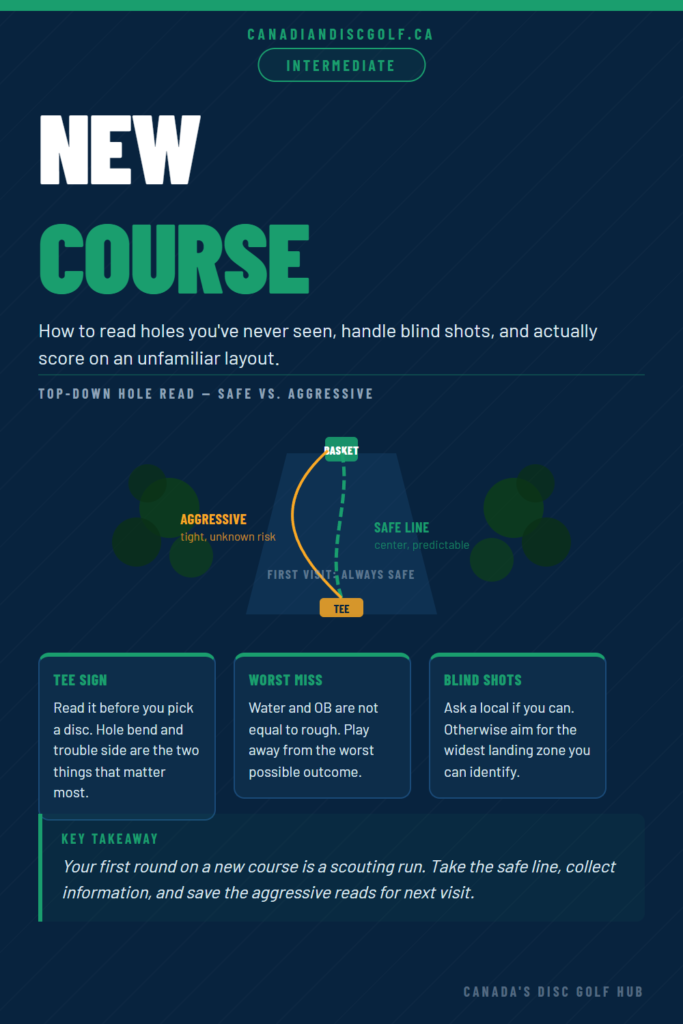
A tee sign gives you the par, the distance, and usually a top-down illustration of the fairway. The illustration won’t be perfectly to scale, but it tells you what matters: where the trouble is, which side the basket is tucked, and whether the hole bends left or right. Thirty seconds of attention here is worth more than any amount of squinting down the fairway from the tee pad.
The detailed breakdown of how to read a disc golf tee sign covers every element on those panels if you want the full rundown. For a new course specifically, focus on two things: the landing zone shape and the basket position relative to the center of the fairway. That tells you whether you need straight, left, or right.
The two questions before every tee shot on a new hole
Before you throw anything, ask yourself: where is the worst miss, and how bad is it?
Some holes have a terrible side and a merely inconvenient side. Water left, rough right — those are not equivalent risks. The penalty stroke plus a difficult lie from the water costs you two or three shots. The rough on the right costs you one, maybe zero if you have a clean look at the basket. Play away from the worst miss, every time, on every hole you’ve never played.
The second question: is the basket visible from the tee? If it is, great. If it isn’t, your target isn’t the basket — it’s the widest, most forgiving landing zone you can identify from where you’re standing. Aim for the zone that leaves you a clear second shot. That’s all. You’re not trying to make a statement on hole one of a course you’ve never seen. You’re trying to make par and gather information.
Use your first round as a scouting run
This is the mindset shift that actually changes your score on unfamiliar courses. You’re not there to shoot your best round. You’re there to learn the course, and every hole gives you data you didn’t have before.
Which side does hole 4 actually play toward? Where’s the hidden elevation change that throws off your distance read? Is that gap at the top of the hill actually throwable or does it look bigger from the tee than it is from fifty feet out? You find out by playing, not by guessing from the tee sign.
Take the conservative line on holes you’re not sure about. Aggressive lines on unfamiliar holes carry hidden penalties you can’t budget for — a slope you didn’t see, a basket placement that’s tighter than the diagram suggested, a gap that closes up as you walk toward it. The cost of being wrong on an aggressive line your first time through is unpredictable. The cost of being wrong on the conservative line is, usually, a bogey. Take the bogey. Note the aggressive option for your next visit.
How to handle blind shots
Blind shots — where you can’t see the basket or the landing zone from the tee — are the most uncomfortable part of a new course for most players. The right move is almost always to ask someone who knows the course, if there’s anyone nearby. There’s no ego involved in asking. Experienced local players love explaining their home course.
If you’re alone or playing with equally unfamiliar company, look for the clues: worn grass from previous throws, a gap in the tree line that suggests a fairway, a slight path through the rough that indicates the intended landing zone. The tee sign will give you a distance. Trust that distance, throw conservatively for your skill level, and walk up to assess before your next shot rather than gambling on a second blind throw.
What to actually do with your bag on hole one
Bring more discs than you think you need to the tee, at least for the first few holes. Not to deliberate endlessly — just to keep your options open until you’ve read the hole fully. Once you know it’s a wide-open 280-foot hole with gentle fade room, you can leave the extra mid in the bag. Until you know, having choices is useful.
On a course you’ve never played, hole one usually sets the tone mentally more than strategically. Throw something you’re genuinely confident in. Not your longest disc, not your flashiest shot. The disc you trust at that distance. Get a par or bogey, start calm, and let the course reveal itself hole by hole.
The players who score best on unfamiliar courses are rarely the ones taking the most aggressive reads. They’re the ones who make good decisions from incomplete information. That’s a skill. It gets better the more new courses you play.