
How Disc Golf Plastic Types Actually Affect Flight
Walk into any disc golf retailer and you’ll find the same mold available in four different plastics at four different price points. The Innova Destroyer comes in DX, Pro, Star, and Champion. The Discraft Buzzz comes in Putter Line, Cryztal, ESP, and Z. Same disc, different plastic, and the assumption most beginners make is that the difference is mostly cosmetic or about how long the disc lasts before it gets scuffed up.
That assumption is wrong in a way that costs players real strokes.
Plastic type affects flight in two meaningful ways: how the disc performs out of the bag on day one, and how that performance shifts over time as the disc takes contact with the ground, trees, and the occasional concrete tee pad. Understanding both changes the way you buy discs, and probably explains some things your current bag is already doing that you haven’t been able to account for.
Grip and Feel
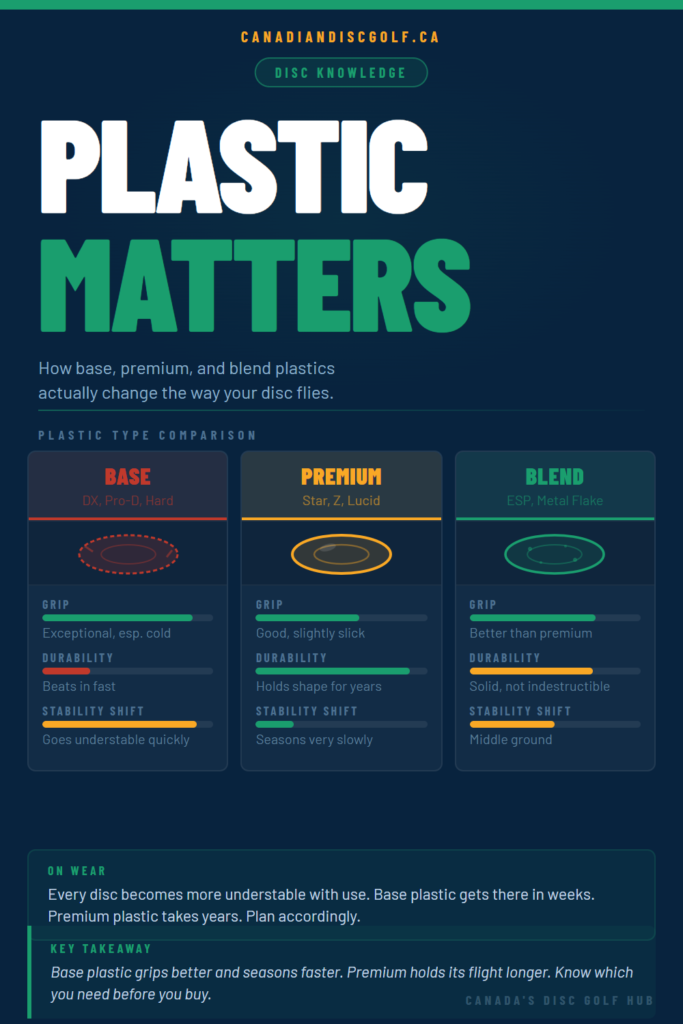
Base plastics, the entry-level stuff like Innova DX, Discraft Pro-D, or Dynamic Discs Classic, are softer and tackier than premium plastics. In cold weather especially, that grip advantage is significant. A stiff Z-plastic Buzzz in November at minus fifteen is a different disc in the hand than a Pro-D version of the same mold. Players who live somewhere with actual winters, which is most of Canada, often keep a base plastic putter or mid-range specifically for cold rounds because the grip difference is that noticeable.
Premium plastics, your Stars, Champions, Z-lines, and Lucieds, are harder and slightly more slick out of the wrapper. They benefit more from chalk or a towel wipe between throws. The trade is that they hold their shape dramatically longer, which matters more than it sounds.
Blend plastics sit in the middle. Discraft ESP, Innova Metal Flake Champion, Dynamic Discs Lucid-X, these are premium-base hybrids that offer better grip than straight premium while still outlasting base by a wide margin. For players who want one disc to do both jobs reasonably well, blends are often the right answer.
How Plastic Changes the Flight Itself
Here’s what most people miss: the same mold in different plastics can fly noticeably differently out of the box, before any wear has occurred. A Champion Roc3 and a DX Roc3 are not the same disc. The Champion version tends to be slightly more overstable because the stiffer plastic holds the mold’s precise shape through the manufacturing process. The DX version, being softer and slightly more variable in production, often runs a touch less stable from the start.
This isn’t dramatic on a mid-range. On a distance driver it matters more. A Champion Destroyer thrown at full power by a player with real arm speed behaves very close to its rated flight numbers. The same player throwing a DX Destroyer at the same power is throwing a disc that’s already partway through its wear cycle before it ever hit a tree, because the softer plastic flexes slightly more on release and in flight.
Understanding flight numbers becomes genuinely useful here: those numbers are usually based on the disc in premium plastic at its design specification. A base plastic version of the same mold is almost always a bit more understable than the rating suggests. For beginners who need understable discs anyway, that’s often a feature rather than a bug.
The Wear Cycle
Every disc becomes more understable as it takes damage. The rim gets beat in from ground contact, the plastic loses some of its rigidity, and the disc’s fade weakens while its turn increases. This is called seasoning, and it happens to every disc regardless of plastic, just at radically different rates.
A DX mid-range thrown into a few trees and rolled across some gravel might be noticeably more understable within a single season. That same mold in Star plastic might take two or three years of regular play to reach the same point. For some players this is a problem. For others it’s a deliberate strategy: they buy base plastic overstable discs and let them season into neutral flyers, getting two discs for the work of one.
The Innova Roc3 is a common target for this approach. In Champion or Star plastic it’s a reliable, predictable mid-range that holds its line for years. In DX it’s the same mold on a fast track to becoming a roller-friendly understable mid. Both are useful. Which you want depends entirely on what gap you’re filling in your bag.
What This Means for Buying Discs
If you’re buying a disc to learn a specific shot shape and you need it to fly consistently while you develop the feel for that throw, buy premium plastic. You want the disc’s behavior to be the constant while your mechanics are the variable. A base plastic disc that’s seasoning under you while you’re still figuring out your release is two moving parts when you need one.
If you’re buying a disc because you want maximum grip for cold weather putting or a specific type of short-game feel, base plastic is often genuinely better for the job, not a cheaper compromise. Putters like the Innova Aviar in DX are beloved by players who’ve owned the same mold in Star and still reach for the base version on cold mornings.
If you’re buying a distance driver and you don’t have the arm speed to take full advantage of a premium overstable driver, a base or blend version of a slightly overstable driver will often fly more like a neutral disc at your power level. This is one of the reasons the Discraft Buzzz SS in ESP or Z plastic behaves differently than the same disc in base plastic for lower-arm-speed players: the softer plastic exaggerates the understability just enough to make it more workable.
A Practical Framework
Drivers: buy premium for consistency and longevity. Reserve base plastic drivers for deliberate seasoning projects or budget replacements.
Mid-ranges: either works. Base plastic gives you a disc that will mellow out over time. Premium gives you a disc that stays true to its rating. Know which you want before you buy.
Putters: base plastic is genuinely underrated, especially for cold climates. Most serious players own putters in both plastics and choose based on conditions.
Blends: a reasonable default for players who want one disc to handle both grip and durability without thinking too hard about it. They’re not the best at either property but they’re solid at both.
The bottom line is that plastic type is not a price tier. It’s a flight and durability specification. Reading it that way changes the math on what a disc is actually worth to your bag.