
How to Develop a Consistent Disc Golf Release Angle
Every serious disc golfer has stood in a field at some point throwing the same disc at the same target ten times in a row and gotten ten completely different flight shapes. The disc goes left, then right, then low, then turns over, then fades out early, and nothing changes except, apparently, something invisible happening at the moment of release. It’s one of the most frustrating experiences in the sport, and it persists longer than it should for most players because the root causes are genuinely hard to observe in real time.
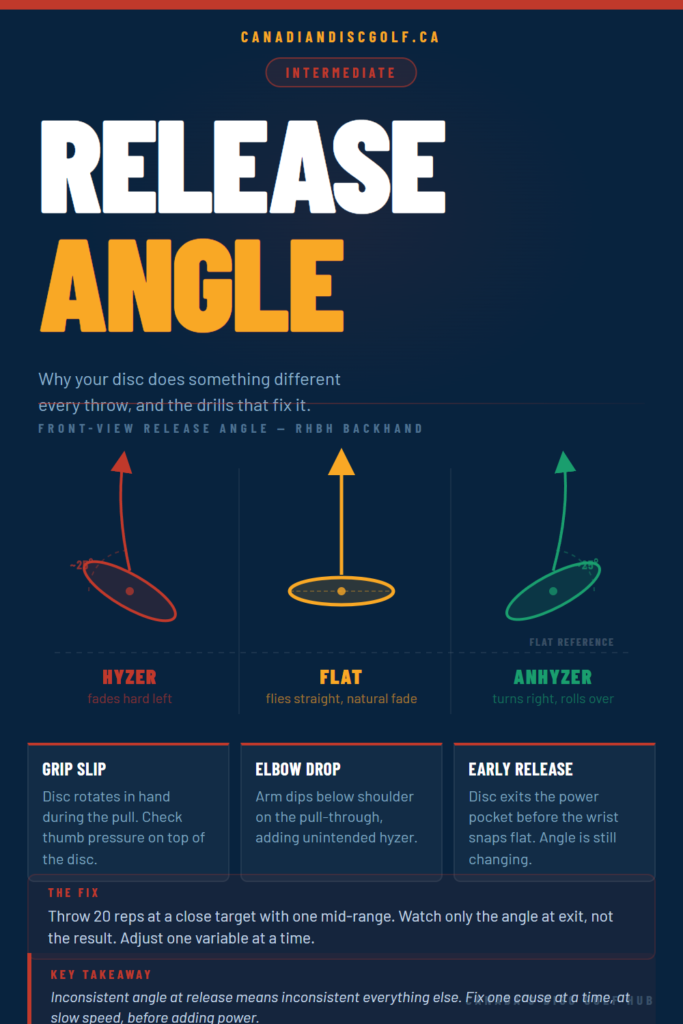
Release angle is the angle at which the disc exits your hand relative to the ground. Flat means the disc is level. Hyzer means the outside edge is tipped downward (left edge down for a right-hand backhand thrower). Anhyzer means the outside edge is tipped upward. A few degrees of difference in any direction translates to dramatically different flight shapes, especially as speed and stability interact with that initial angle. A disc released on three degrees of unintentional anhyzer might behave fine at low power and turn over completely at full power. The flight numbers are working exactly as designed. The variable is you.
Understanding what those flight numbers are actually predicting about your disc is step one. If you haven’t spent time with a breakdown of how disc flight numbers work, this is the right moment. The reason release angle matters so much is precisely because disc stability amplifies whatever angle you start with. An overstable disc released on hyzer fades aggressively left. The same disc released on the same hyzer angle but thrown harder fades even more aggressively. You’re not fighting the disc, you’re working with physics that compounds your input rather than averaging it out.
Why Angle Changes Throw to Throw
The angle at release isn’t usually a conscious decision. You don’t decide on hyzer and execute. The angle is the result of everything that happened in the two seconds before the disc left your hand, which means any inconsistency anywhere in the chain produces angle variance at the end.
The three most common culprits are grip pressure and disc rotation during the pull, elbow height through the power pocket, and release timing.
Grip issues are underappreciated. If your grip is too loose, or if the thumb on top of the disc isn’t providing consistent downward pressure throughout the throw, the disc can rotate slightly in your hand during the acceleration phase. A disc that rotates even a small amount from its starting position exits your hand at a different angle than the one you set up with. Check that your thumb is actively pressing down on the top of the disc through the entire pull, not just at the start of the motion.
Elbow height is the second common source of unintentional hyzer. When the throwing elbow drops below shoulder height during the pull-through, the natural result is a disc path that angles downward on the outside edge. The disc follows the arm’s plane of motion, so a low elbow creates a low-outside-edge (hyzer) release whether you intend it or not. Players who throw with a significant drop in elbow height often develop a chronic hyzer that no amount of conscious adjustment fully corrects because the problem is structural rather than intentional.
Release timing, specifically the difference between releasing through the power pocket versus releasing early before the snap completes, creates angle variance because the wrist is still in motion when the disc comes off the fingers. If the disc is leaving your hand before your wrist has snapped to its flat endpoint, you’re releasing at whatever angle the wrist happens to be at that moment in its rotation. That angle changes slightly with every throw based on arm speed and timing, which explains why the same apparent throwing motion produces erratic results.
Why Power Exposes Problems
A release angle problem that’s barely visible at half power becomes dramatic at full power, for the same reason that a slightly misaligned wheel on a car is fine at thirty kilometres an hour and alarming at highway speed. More force through an imperfect vector produces a bigger deviation. Players who are working on adding distance will sometimes notice their accuracy gets dramatically worse as they throw harder, and conclude that they just can’t control their power level. What’s usually happening is that a small angle inconsistency, tolerable at moderate speed, is being exposed by the additional force.
This is why throwing drivers before your technique is dialled in tends to reinforce bad habits rather than build good ones. The hyzerflip shot illustrates this directly: it requires throwing an understable disc on a specific hyzer angle and matching power to that angle to get the disc to flip up to flat. If your hyzer angle is inconsistent from throw to throw, the hyzerflip either turns over completely or never flips at all, and neither result teaches you what went wrong. The disc can only respond to what you actually gave it.
The Mid-Range Is Your Diagnostic Tool
Getting control of your release angle means slowing down and using a forgiving disc that gives honest feedback. A neutral-to-stable mid-range is the right tool for this, not a driver. The Discraft Buzzz and the Dynamic Discs Truth are both used heavily for this kind of diagnostic work because they fly predictably close to their rated behavior across a wide range of arm speeds, which means their flight shapes tell you something real about your input rather than masking it.
Set up a target at a comfortable distance, somewhere between twenty and thirty metres. Throw ten reps with one disc. For each throw, your only focus is observing the angle at which the disc exits your hand. Not where it lands, not how far it went. Just the angle at exit. If you can, film yourself from the front at about one-third speed. What your release angle looks like in real time and what it looks like on video are often surprisingly different things.
Look for three things: is the disc flat when it leaves your hand, or is one edge consistently higher or lower? Is there any visible rotation of the disc between when you grip it and when it releases? And does the angle change between low-effort throws and high-effort throws?
Drills That Actually Move the Needle
The most effective drill for release angle consistency is the wall drill or equivalent. Stand about a body-length from a wall and make slow, controlled pull-through motions without releasing the disc. Focus on keeping the disc parallel to the wall (and therefore flat) throughout the motion. You’re not throwing, you’re wiring the feel of a flat pull-through into your muscle memory at a speed slow enough to actually observe and correct. Do this twenty to thirty times before a practice session and it will transfer.
The second drill is reach-back angle setting. Before every practice throw, consciously set your release angle at the reach-back point and make a deliberate choice about what angle you want to throw. Most players reach back without thinking about angle and then wonder why the angle at release is inconsistent. Setting it deliberately at the start of the motion gives the throw a target to maintain rather than just hoping the body figures it out.
The third is the distance progression. Start at fifteen metres with half power. Confirm the flight shape is what the disc’s stability predicts. Step back to twenty-five metres, same power. Then thirty-five. If the flight shape changes significantly between distances at the same power level, something in your mechanics is shifting with the added reach or body rotation of the longer throw. Find where it changes and that’s where to focus your drilling attention.
The Mental Piece
Inconsistency in release angle is also partly a focus problem. Most players, during a round, are thinking about where they want the disc to land, what the score is, or what club a golfer would use on this shot. Almost nobody is thinking about the angle at which the disc will leave their hand. During practice sessions specifically, that has to change. The release angle is the last physical variable you control before the disc is in the air. Everything else, disc selection, stance, power, is setup. The release is execution.
One cue that works for a lot of players: think about the bottom edge of the disc. For a flat release, the bottom of the disc should be parallel to the ground at the moment of release. Not the top, not the rim, the bottom. This gives you a concrete physical reference to aim for rather than the abstract concept of “flat,” which means different things to different people depending on how they visualize it.
Consistent release angle won’t happen from one session of focused work. It will happen from twenty sessions, and then one round where you notice that your flight shapes are more predictable than they’ve ever been and you’re not completely sure when that changed. That’s how technique solidifies. Quietly, with repetition, until the right thing becomes the automatic thing.