
Disc Golf Etiquette: Unwritten Rules Every Player Should Know
There’s an official rulebook for disc golf. The Professional Disc Golf Association publishes it, it runs to dozens of pages, and it covers everything from how to mark your lie to what happens when your disc lands in a lake. Most recreational players never read it. That’s fine. But there’s another set of rules that doesn’t appear anywhere in that document, rules that get transmitted person to person on courses across the country, and breaking them will earn you looks that are hard to misread. Learning them early saves everyone a lot of awkwardness.
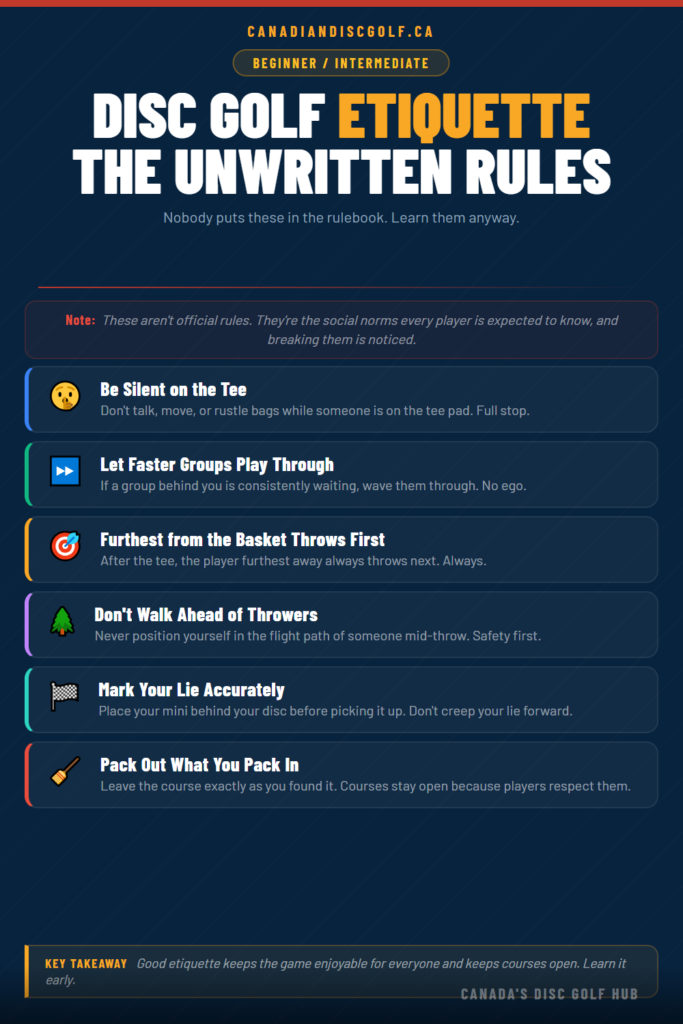
The most important one, and the one new players most often violate without realizing it, is silence on the tee. When someone steps onto the tee pad to throw, everything stops. No talking, no rustling through your bag for a snack, no shuffling your feet, no side conversations with the person next to you. The player throwing is trying to focus, and disc golf is a precision sport where a broken concentration at the wrong moment genuinely affects the shot. Most experienced players don’t say anything the first time it happens because they assume it was accidental. By the second or third time, they notice. Give people quiet when they’re throwing and expect the same in return.
Play order matters too, and it has two phases. On the tee pad, the player who scored lowest on the previous hole throws first. That’s called the honor, and it’s straightforward enough. After everyone has teed off, play continues in order of who is furthest from the basket. The player with the longest remaining shot goes next, then the next furthest, and so on until everyone has putted out. This isn’t just tradition, it’s also safety. Nobody should be walking downrange while someone behind them is still throwing.
Speaking of safety: never position yourself ahead of a player who is about to throw. This means don’t walk up the fairway while your playing partner is still on the tee. Don’t stand anywhere near the landing zone while someone is mid-throw. And if you’re retrieving your own disc in a wooded area, make sure the people behind you know where you are before they throw. Yelling fore when a disc goes somewhere unexpected is also expected, not optional. If your disc is heading toward other players or hikers on an adjacent hole, you call it immediately and loudly.
If you’ve ever been confused about what you’re supposed to do once your disc lands, reading how to read a disc golf tee sign will help with the broader picture of how a hole is laid out and what the markers mean. But once you’re mid-hole, the standard process is this: when you reach your disc, place a mini marker disc behind it before picking it up. This marks your lie. Don’t inch it forward. Don’t conveniently place it a foot closer to the basket than where the disc actually landed. Other players see this more often than you’d think, and nothing damages your reputation in a local group faster than a reputation for cheeping your lie.
Pace of play is another area where etiquette matters. If your group is taking significantly longer than the group behind you to complete each hole, and those players are consistently waiting at tees, wave them through. It costs you two minutes and eliminates what would otherwise become a frustrating round for everyone. Most players are happy to let a slower group keep their pace as long as they’re acknowledged and given the option to pass. Being ignored while waiting is what actually bothers people.
The last piece is the simplest: leave the course the way you found it, or better. Pack out any garbage, don’t carve things into trees, don’t trample vegetation around the basket retrieving a disc that went long. Disc golf courses exist on public land, in parks, and on property that municipalities and private landowners have chosen to make available for the sport. Courses get closed when players demonstrate they can’t be trusted to treat the space with basic respect. The history of disc golf in Canada includes plenty of courses that no longer exist because of exactly this problem.
None of these rules are complicated. They’re just not written anywhere obvious, which means the only way most players learn them is by playing with people who already know them or by accidentally breaking one and reading the room. Getting ahead of it is straightforward: be quiet when others throw, follow play order, don’t walk ahead of active players, mark your lie honestly, let faster groups through, and clean up after yourself. Do those six things consistently and you’ll fit into any group at any course without friction.
The rest you’ll pick up as you go.