
How to Read the Wind on a Disc Golf Course
Nobody talks about it at the beginner stage. You’re still figuring out your grip, your footwork, why your driver keeps crashing into the ground thirty feet in front of you. Wind is the last thing on your mind. But at some point, usually mid-round when the gusts pick up and every disc you throw starts doing something completely unexpected, you realize there’s a whole other layer to this game you haven’t touched yet. Reading wind is that layer. And honestly, it separates recreational players from serious ones faster than almost anything else.
Here’s the thing about wind and disc flight: wind doesn’t just push your disc sideways. It actively changes how the disc behaves in the air, interacting with the spin, the speed, and the stability rating in ways that aren’t obvious until someone explains the mechanics. If you’ve already spent time understanding disc golf flight numbers, you have a head start. If not, it’s worth going back to that foundation first. Either way, what follows applies directly to your disc selection and shot shaping in real conditions.
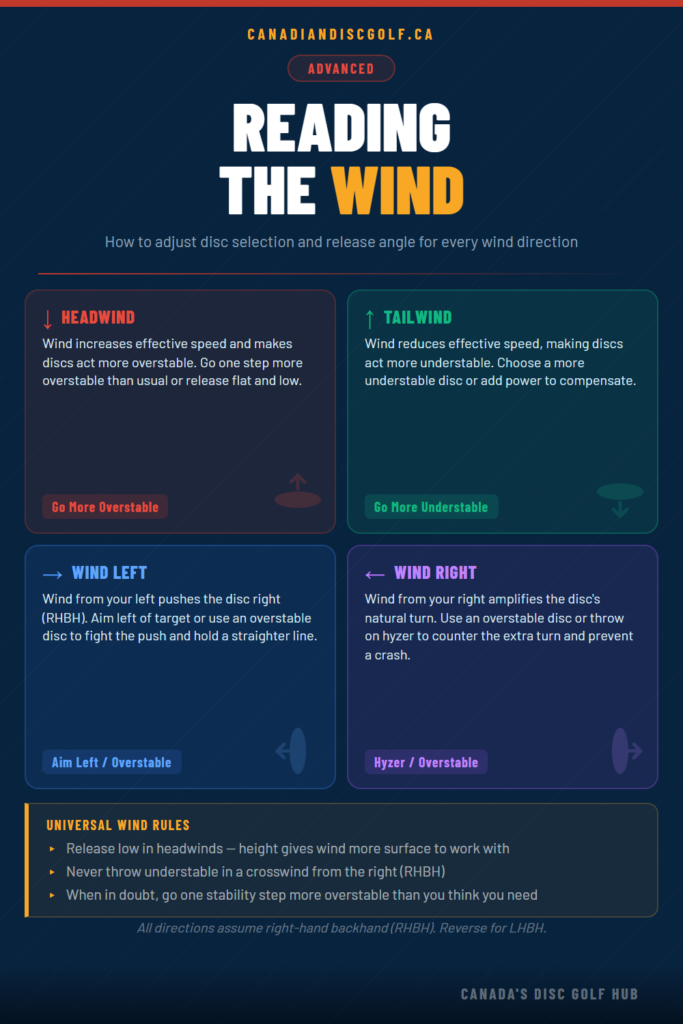
Start with headwinds, because they’re the most counterintuitive. Your instinct when throwing into a headwind is probably to throw harder. Don’t. Well, not exactly. What a headwind actually does is increase the effective airspeed over the disc, which makes the disc behave as if it’s more overstable than its rating suggests. A disc rated at neutral to slightly understable will fight and fade hard. An understable disc that normally flips and turns will suddenly fly much straighter, or even fade out. The practical adjustment: go one stability step more overstable than you’d normally choose for that distance, and keep the release low. The lower you release in a headwind, the less surface area the wind has to get underneath the disc and throw off the flight.
Tailwinds are almost the opposite problem. The wind behind you reduces effective airspeed, which makes discs act more understable than their rating. Your reliable overstable fairway driver might glide out and turn over when you’re throwing with a strong tailwind. In a tailwind, reach for something more overstable than you think you need, or add a little more arm speed to compensate for the reduced airspeed effect. Some players also drop down to a slower disc in tailwinds, trading raw speed for more predictable behavior.
Crosswinds are where a lot of rounds fall apart for players who haven’t thought this through. A wind coming from your left (for right-hand backhand throwers) pushes the disc rightward. That sounds like a gift if you’re trying to throw right, but it also means your disc’s fade at the end of the flight gets complicated. Aim further left than your target and let the wind bring it back, or grab a more overstable disc that resists the push. A wind from your right is genuinely dangerous for understable discs. That wind direction works in the same direction as the disc’s natural turn, amplifying it dramatically. Throwing an understable disc into a right-to-left crosswind (again, RHBH) is a reliable way to watch your disc immediately roll into the rough. Throw on hyzer, go overstable, and don’t fight the wind by aiming way right and hoping it works out.
A few principles that hold across all wind directions. Never throw understable discs in strong crosswinds from the right if you’re a RHBH player. It will turn over. Every time. Release low in headwinds, always. Height gives the wind more surface area to work with and more time to push your disc off line. And when you’re genuinely uncertain, default to one stability rating more overstable than you planned. Overstable discs are far more forgiving in wind than understable ones. They might not go as far, but they’ll finish in roughly the right place.
The last piece of this is something that takes real rounds to develop: the ability to feel how strong the wind actually is before you throw. Watch the trees. Watch the grass. Watch what happens to other players’ shots on nearby holes. Wind swirls, especially on wooded courses where it comes through gaps unpredictably. What’s blowing at the tee pad might be completely different thirty meters down the fairway. Factor that in. The best wind players aren’t necessarily the ones who adjust their disc selection perfectly every time. They’re the ones who stay patient, accept that wind rounds are harder and scores will reflect that, and make smart percentage decisions instead of fighting conditions that can’t be beaten outright.
That patience, more than any specific technique, is what the wind actually teaches.